
Gold mining is two industries that happen to share a name. One employs around a million people and produces roughly 85 % of the world's gold; the other employs 15 to 20 million and produces the rest. This article is the overview: where gold came from, how it is mined, what that costs, and who ends up with the money.
Key Insights
- More than half of all the gold ever mined has come out of the ground since 1980. Humanity has mined around 222,600 tonnes in total – a cube roughly 22.6 meters on a side.
- The crust holds about 4 grams of gold per billion grams of rock. Every tonne of waste rock, every liter of cyanide and every hectare of cleared forest follows from closing that gap.
- Two industries, one metal. Industrial mining produces most of the gold with very few people; artisanal mining produces around 15 % of it and carries 90 to 95 % of the sector's employment.
- The method matters more than the size of the operation. A factor of about 100 in emissions separates the cleanest gold mine on record from the dirtiest, and that spread exists inside both industries.
- Money reaching a country is not money reaching its people. Gold mining pays tens of billions into host economies each year. At the same time, more than a tonne of gold a day leaves Africa undeclared.
Table of Contents
- Where the world's gold came from
- Where gold sits in the ground
- A short history of gold mining
- How much gold is mined, and where
- Two industries, one metal
- How gold is taken out of the ground
- From ore to metal: crushing and chemistry
- Where traceability ends: the refinery
- What gold mining costs the environment
- What it costs the people who mine it
- Does the money stay?
- What better gold mining looks like
- Key takeaways
Where the world's gold came from
Forged in collisions between stars
Practically every gram of gold on Earth arrived from space. Gold cannot form on a planet. It takes an environment violent enough to force neutrons into atomic nuclei faster than those nuclei can decay, a process called the r-process.
Astronomers saw it happen in 2017, in the debris of a collision between two neutron stars. A 2025 study adds giant flares from magnetars as a second source, possibly accounting for up to 10 % of the Milky Way's heavy elements.1 Both remain working theories.
Delivered by a late bombardment
Getting that gold within reach was a second journey. Gold binds to iron, so when the young Earth melted and its iron sank to form the core, nearly all of it should have gone down too. Yet the mantle and crust hold tens to thousands of times more gold than that allows.
The leading explanation is a late bombardment. After the core had formed, meteorites delivered fresh material that stayed in the mantle, and isotope analysis of the planet's oldest rocks supports it.2 So the gold in a wedding ring is older than the planet it came from, and it is only reachable because the Earth was hit hard, late, and often.
Where gold sits in the ground
Four grams in a billion
Gold makes up about 4 parts per billion of the Earth's crust – 0.004 grams per tonne of rock.3 An ore body worth mining is enriched two to three orders of magnitude above that background, so roughly 250 to 1,000 times.
Geology does that concentrating work first; mining only finishes it. Almost every impact in this article follows from how far there is left to go.
Lode deposits and placer deposits
Two kinds of deposit supply the world's gold. Lode deposits hold gold locked in solid rock, mostly in veins formed where hot mineral-bearing fluids moved through the crust and cooled.
Placer deposits form later and elsewhere. Weathering frees the gold from its host rock, and moving water concentrates it by weight in riverbeds and floodplains.3 The practical difference is large: lode gold has to be blasted, crushed and ground, placer gold can often simply be washed out.
One basin, a third of all the gold
One geological accident supplied around a third of all the gold ever mined. The Witwatersrand Basin in South Africa, formed about 2.7 billion years ago, has yielded 30 to 40 % of the world's historical production.
Chasing those reefs downward produced the deepest mines on the planet. Mponeng reaches roughly 4 kilometers below the surface, into rock hot enough to require industrial cooling.4
A short history of gold mining
From streambeds to the Spanish conquest
People have washed gold out of streambeds since prehistory and worked it since around 3000 B.C., when Sumerians, Egyptians and Cretans had already mastered casting and wire-drawing.3 For most of those five thousand years, output stayed tiny.
The Spanish conquest of the Americas brought the first real supply shock. Spain took in roughly 154 tonnes across the entire 16th century – a large share of world production at the time.3
The century of the gold rushes
The 19th century changed the scale of everything. California in 1848 lifted world production from about 1 tonne a year in the 1830s to 83 tonnes a year over the 1850s. Australia followed in 1851 and matched that output over two decades, and the Klondike yielded 62 tonnes between 1897 and 1899.3
Then, in 1886, prospectors found the Witwatersrand reefs – a discovery that would dwarf every rush before it and turn gold mining into a permanent industry rather than a series of stampedes.
Cyanide changes the economics
One invention made the modern industry possible: cyanide. Patented in 1887 and in commercial use by 1890, cyanide leaching allowed gold to be recovered from South African ores and many other difficult ore types that had been worthless before.3
Gold mining stopped being a hunt for visible nuggets and became an industrial process for extracting invisible grams – the basis of today's low-grade, high-volume mining.
How much gold is mined, and where
Production today
The world's mines produced 3,671.6 tonnes of gold in 2025, more than in any year before. Recycling added another 1,404.3 tonnes, bringing total supply to 5,002.3 tonnes.5 Mining still accounts for close to three quarters of the gold entering the market each year, and prices are at record levels, which keeps the pressure on both sources.6
Production is spread across dozens of countries but concentrated in a handful. For 2025, the US Geological Survey estimates China at 380 tonnes, Russia at 310, Australia at 280, Canada at 200 and the United States at 160 – together 41 % of global output. Ghana leads the African producers at 150 tonnes.7
Every gram ever mined
All the gold ever mined amounts to roughly 222,600 tonnes. That is a cube about 22.6 meters on a side, shorter along each edge than a tennis court is long.8
Around 45 % of it sits in jewelry, 21 % in bars and coins and 18 % in central bank vaults, and because gold is essentially indestructible, almost all of it still exists.9 More than half of that total has been mined since 1980 – five thousand years of gold working, and most of the metal came out in the last 45 years.10
Will the gold run out?
Identified reserves stand at around 66,000 tonnes, roughly twenty years of production.11 That is not a countdown. Reserves are what is economic to mine at today's prices and technology, so they have been running out in twenty years for decades.
The real constraint is time: across 127 mines studied by S&P Global, the average interval from discovery to production was 15.7 years.12 Supply cannot follow demand quickly.
Two industries, one metal
Large-scale and small-scale mining
Gold mining splits into two worlds that share almost nothing except the product. Large-scale gold mining is mechanized and capital-intensive, run mostly by international companies working low-grade deposits at enormous volume.
Artisanal and small-scale gold mining works the other way around: simple equipment, a great deal of manual labor, very little capital. The OECD's definition is the one the industry uses:
"Formal or informal mining operations with predominantly simplified forms of exploration, extraction, processing and transportation. ASM is normally low capital intensive and uses high labour-intensive technology."13
Little gold, a great many people
The numbers make the contrast concrete. Artisanal mining accounts for around 15 % of the world's mined gold, by some estimates up to 20 % – roughly 500 to 600 tonnes a year.14 It also accounts for 90 to 95 % of all employment in gold mining.15 Between 15 and 20 million people work in it directly, and more than 100 million depend on it.16
Per kilogram of gold, artisanal mining therefore supports around a hundred times as many people – 25 to 40 workers per kilogram against about 0.32.17 Turned around: an artisanal miner produces roughly one troy ounce a year, an industrial employee about a hundred. That ratio is why social impact in this sector is settled in the small-scale segment.
Small-scale is not the same as illegal
One distinction gets blurred constantly. Artisanal operations fall into three groups – formalized, informal and illegal – and the largest group by far is the middle one.
Informal mining is not prohibited, only unregistered, because formalization is too slow and too expensive to reach. Much of what headlines call illegal gold mining is, in legal terms, informal mining by people who would rather be working legally. We compare both sectors in small-scale versus large-scale gold mining.
How gold is taken out of the ground
Four methods of extraction
Four methods dominate, and the deposit dictates the choice:
- Open-pit mining strips overburden to reach broad, low-grade ore bodies, and moves the largest volumes of material of any method.
- Underground mining follows richer veins through shafts and tunnels, disturbing far less at the surface but exposing workers to far more risk.
- Alluvial mining washes gold-bearing gravel over sluices, often using high-pressure water.
- Dredging pulls sediment straight out of riverbeds with suction or bucket equipment.
Ore grade governs everything else
Industrial open pits process ore averaging around 1 gram of gold per tonne of rock; underground operations average closer to 3 grams.18 Artisanal miners working hard rock target veins holding 10 to 50 grams per tonne, because anything leaner cannot be worked profitably by hand.19
Low grades mean moving mountains. One kilogram of gold from industrial mining requires moving and processing between 100 and over 1,000 tonnes of ore and waste rock.20 Artisanal hard-rock mining moves considerably less; artisanal alluvial mining moves more, because river sediment is poorer still. The pattern is not large against small – it is rich rock against poor rock.
The scale at the top end
At the top end the scale is hard to picture. The Grasberg district in Papua, Indonesia, holds one of the world's largest recoverable gold reserves, and its open pit alone produced more than 1,400 tonnes of gold in the thirty years to 2019. The pit is roughly 4 kilometers across – wide enough that astronauts have photographed it from the International Space Station.21
From ore to metal: crushing and chemistry
Crush it, concentrate it, extract it
Getting gold out of rock takes three steps: crush it, concentrate it, then dissolve or melt out what remains. How finely the ore is ground determines both how much gold comes out and how much chemistry is needed to get it.
Concentration itself is purely mechanical – sluices, shaking tables, centrifuges – and it is the quiet lever in the whole process. A well-run concentration stage cuts chemical use more than anything else downstream, because whatever never enters the chemical step never has to be treated.
Mercury and cyanide
Two substances do the final separation, and they are not equivalent. Cyanide leaching recovers a high share of the contained gold, often around 90 %. Mercury binds gold into an amalgam that is then heated off, which is simpler and cheaper and used almost exclusively in the artisanal sector.
How much mercury is used depends entirely on practice. Amalgamating the whole ore consumes four to twenty times as much mercury as the gold it recovers; amalgamating only the concentrate cuts that to roughly one to 1.3 times, and retorts capture most of the vapor.19
They also behave differently once released. Mercury is a neurotoxin that accumulates in the food chain and stays there. Cyanide is acutely dangerous but breaks down in the environment and does not build up in the body. Handled properly, cyanide is part of the way out of mercury; handled carelessly, either does serious damage.
Where traceability ends: the refinery
What refining actually does
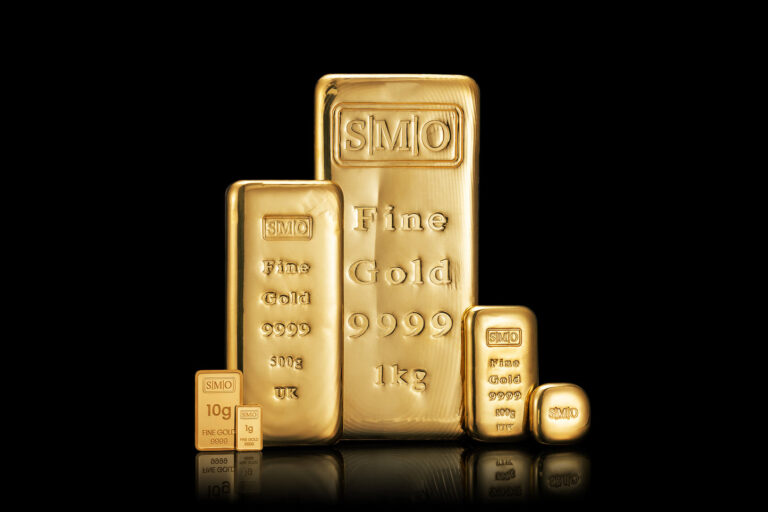
Mines do not ship finished metal. They ship doré – rough bars, often only a few hundred parts per thousand fine, still carrying silver, copper and traces of whatever else the ore contained. Refineries strip all of that away.
The usual result is 999.9 fineness: 99.99 % gold, less than one part in a thousand of anything else. The bar is then close to the pure element, and one atom of gold is identical to the next.
Why origin cannot survive it
That purity is exactly what makes refined gold untraceable by analysis. Gold refined to 999.9 is indistinguishable from any other gold refined to 999.9 – young or old, from a large mine or a small one, from a conflict zone or from a scrap dealer's melt. Refineries then compound it, because metal from many suppliers is processed and cast together.
Origin is therefore a documentation problem, not a chemistry problem. It is also why recycled gold and freshly mined gold become the same product at the refinery gate, and why knowing where gold came from takes an independently audited chain of custody rather than an assay.
What gold mining costs the environment
Deforestation, and the Amazon
Gold is the single largest driver of mining-related deforestation worldwide. Between 2001 and 2023, mining destroyed 19,765 square kilometers of forest; gold accounts for 41.7 % of that, ahead of coal at 26.3 %. Nearly three quarters of the gold-related forest loss – 73.2 % – comes from mining that appears in no official register.22
The Amazon shows what that looks like on the ground. The region's cumulative mining footprint passed 2 million hectares by 2024, more than half of it cleared in the six years from 2019, with Brazil accounting for 55 %.23 In the Peruvian Amazon alone, gold mining had stripped 139,169 hectares by mid-2025, 97.5 % of it in Madre de Dios.24
Alluvial mining leaves sand, rubble and mercury-laden pools. Without topsoil, that landscape does not reforest on its own.
Mercury in rivers and people
Mercury use in artisanal gold mining makes the sector the world's largest man-made source, at around 37 % of global anthropogenic emissions.25
The damage travels far beyond the mine. Mercury reaches rivers, microorganisms convert it into methylmercury, it accumulates in fish, and it ends up in people who have never been near a mine.
When a tailings dam fails
On the industrial side, the defining risk is the tailings dam. Processing leaves vast volumes of fine, wet waste behind embankments that have to stand permanently, and when they fail they fail catastrophically.
Gold's textbook case is Baia Mare in Romania. On 30 January 2000, a dam at a plant reprocessing old gold waste overflowed and sent around 100,000 cubic meters of cyanide-bearing water down the Somes into the Tisza and the Danube, killing fish across three countries and contaminating village wells.26
The 2019 collapse at Brumadinho in Brazil killed 272 people and finally moved the industry. It triggered the first Global Industry Standard on Tailings Management, 77 requirements binding on ICMM members from 2023 and 2025.27
The mines nobody closes
What happens after the gold runs out is the quieter scandal. Closing a mine properly means treating the water, stabilizing the waste, removing the infrastructure and restoring the land – expensive work, all due at the moment the revenue stops. Many operations never get there.
South Africa, the country that supplied a third of the world's gold, counted 6,100 abandoned mines in 2021. Of 2,017 sites assessed in 2007, just 0.7 % had been rehabilitated, and the cleanup bill was put at 100 billion rand almost two decades ago.28
The ways out are well worn: liquidation once the ore is gone, sale of depleted sites to firms without the means to close them, or indefinite care and maintenance. The cost does not disappear. It transfers to whoever still lives there.
Climate: the category tells you little
Industrial gold mining averages roughly 23 to 33 tonnes of CO₂ equivalent per kilogram of gold. The artisanal sector average, measured across 47 sites in the Brazilian Amazon, is around 16 tonnes within a range of 10 to 30.29 The studies use different system boundaries and are not directly comparable.
What is comparable is the spread. Between the best and the worst individual operation on record, in both industries, lies a factor of around 100. More in our overview of gold's environmental impact.
What it costs the people who mine it
Work without safety
Artisanal mining lacks almost everything that makes work safe. Tunnels are driven without engineering and entered without adequate support, and collapses are among the most common causes of death.
The slower damage is just as real. Silica dust causes silicosis, an incurable lung disease; protective equipment is scarce, and medical care in remote mining areas scarcer. The International Labour Organization counts more than a million children working in mines and quarries worldwide, across all commodities.30
Debt before the first gram
The economics are rigged before the first gram is dug. Without a concession there is no bank loan, and without a loan there is no equipment – so traders pre-finance tools, fuel and mercury against a share of the output.
In Ghana, the OECD describes a common arrangement in which 30 % of production goes to the concession holder and 40 % to the sponsor. Only what is left gets split among the people doing the digging.31 Many are paid on results alone, with no wage at all if the rock comes up empty.
A miner who has been pre-financed also cannot wait for a better price or sell elsewhere. The exploitation is not an accident in the system. It is the system.
Conflict gold and smuggling
Where the state is weak, gold funds the people with guns. In eastern Democratic Republic of the Congo, 85 % of surveyed artisanal miners work in gold. Of roughly 132,320 miners recorded, 61 % were subject to interference – illegal levies imposed by armed actors. Non-state armed groups were present at 29 % of the mine sites visited, units of the Congolese army at 37 %.32
A great deal of the metal then simply disappears. In 2022 alone, at least 435 tonnes of gold left Africa undeclared – more than a tonne a day.33 More in our overview of gold's social impact.
Does the money stay?
What the industry pays in
Gold mining moves large sums into the economies where it happens. In 2024, the 28 member companies of the World Gold Council – 220 mines across 36 countries – contributed 66.4 billion US dollars to their host economies: 43.6 billion to in-country suppliers, 12.4 billion in wages, 10.4 billion in taxes and royalties and 740.9 million to local communities and Indigenous groups.
They employed 220,879 people plus 160,501 contractors, 97 % of them from the host country.34 Those companies account for roughly a third of world mine production, so the industry-wide figure is considerably larger.35
The resource curse
Money reaching a country is still not money reaching its people. The Resource Governance Index assessed 81 resource-rich countries and found 66 of them weak, poor or failing in how they govern extractive industries; fewer than 20 % rated good or satisfactory. Its own summary of the pattern:
"The gap between law and practice is larger in countries where corruption is systemic."36
Economists have a name for what follows: the resource curse. Many countries rich in oil, gas or minerals have ended up poorer and less stable than comparable countries without those deposits. An IMF working paper finds a significant negative direct effect of natural resource wealth on income per capita, running partly through weakened institutions and hitting hardest where governance and trade openness are poor.37
What mining can get right
None of that is a verdict on mining itself. A gold mine can be the largest employer for a hundred kilometers, the reason a region has a road, a clinic and a school, and the only formal-sector wages within reach. In many places it is exactly that.
The difference between a mine that builds a region and one that funds a patronage network is not the metal, and not the size of the operation. It is governance on both sides of the transaction: how the host country handles the revenue, and how carefully the buyer at the other end of the chain looks.
What better gold mining looks like
Method, not size
The most useful finding in all of this data is that damage tracks the method, not the size of the operation:
- Rich rock beats poor rock, because less of everything has to be moved and treated.
- Underground beats stripping the surface, for forests, farmland and neighbors.
- Proper concentration beats dumping mercury on whole ore, by a factor of several.
- Closing a mine properly beats walking away from it.
None of these waits on technology that does not yet exist. They wait on capital, training and someone willing to pay the difference.
The standards that exist
A framework has been built over the past two decades, and it works on two levels.
Due diligence is the baseline. The OECD's guidance for mineral supply chains sets out how companies should identify and manage risks in their sourcing, and most industry schemes build on it.13
Certification and traceability go further, because they attach requirements to the mine itself. For artisanal mining, the Fairmined and Fairtrade systems audit mining organizations against rules on mercury handling, working conditions, child labor and the physical separation of certified metal.38 For large-scale mining, programs such as Single Mine Origin keep each batch traceable to one named mine.
Neither covers a large share of the market today. Both show that the thing can be done.
Exclusion removes the visibility
Shutting the harder supply out does not fix it. Of the 5,038 tonnes that London Good Delivery refiners processed in 2020/21, just 21 tonnes were recorded as artisanal gold – around 3 % of estimated artisanal production.
The London Bullion Market Association describes a trend among refiners to "de-risk" by declining artisanal gold altogether, and notes that "most ASM gold will enter international markets via the paths of least resistance."39 Exclusion does not remove the gold from the market. It removes the visibility.
Which leaves the buyer
A mine can finance safety equipment, environmental controls, decent conditions and its own closure only if someone at the other end of the chain pays for them reliably, over years.
Asking where gold comes from is therefore not a gesture. It is the signal that settles whether doing it properly pays. What that looks like in practice: our responsible gold mine profiles and our overview of sourcing models.
Key takeaways
- Rarity explains the footprint. At 4 parts per billion in the crust, every gram of gold means enormous quantities of rock moved and treated. Ore grade predicts energy, waste, water and chemistry better than any other single number.
- The mine matters more than the label. A factor of roughly 100 separates the best operation from the worst inside both industries. The useful question is never "large or small" but "which mine, run how".
- Origin does not survive the refinery. Once gold is refined to 999.9 and cast with other metal, no analysis can tell you where it came from. Only an independently audited chain of custody can.
- Revenue is not the same as benefit. The industry paid 66.4 billion US dollars into host economies in 2024, and more than a tonne of gold a day still leaves Africa undeclared. Which of those a country gets is decided by governance, not geology.
- The bill comes due at closure. Thousands of mines have been abandoned without rehabilitation, and the cost transfers to whoever still lives nearby. A mine is well run only if it is funded to be closed properly.
What to do next
Gold will keep being mined for as long as it has value, and that value is not going away. Every gram bought is a vote for one version of this industry or the other. So whether you buy gold by the kilogram or once in your life for a wedding ring, the next step is the same: ask your supplier which mine the metal came from, and ask to see the documentation. You can find gold with documented origin in our shop.
Further reading
- The small-scale side in depth: artisanal and small-scale gold mining.
- The industrial side in depth: large-scale gold mining.
- The two compared: small-scale versus large-scale gold mining.
Sources
- Patel, Barnes, Metzger et al., Direct Evidence for r-process Nucleosynthesis in Delayed MeV Emission from the SGR 1806−20 Magnetar Giant Flare, The Astrophysical Journal Letters, 2025 – summarized by The Ohio State University, Study reveals new source of the heavy elements, 2025 (2017 neutron star merger as direct evidence; estimate of up to 10 % of the Milky Way's heavy elements from magnetar flares). ↩
- Willbold, Elliott & Moorbath, The tungsten isotopic composition of the Earth's mantle before the terminal bombardment, Nature 477, 2011 – 3.8-billion-year-old rocks from Isua, Greenland, show a 15-parts-per-million shift in tungsten isotopes consistent with a late meteorite addition. Plain-language summary via University of Bristol / ScienceDaily, 2011. ↩
- Butterman & Amey, Mineral Commodity Profiles – Gold, U.S. Geological Survey Open-File Report 02-303, 2002 (crustal abundance 0.004 g/t; enrichment of economic deposits by two to three orders of magnitude; lode and placer formation; history of gold use, Spanish colonial supply, the 19th-century gold rushes; cyanide process patented 1887, in use by 1890). ↩
- SRK Consulting, 140 Years of Mining the Witwatersrand Basin – the basin has supplied "30–40% of all the world's gold ever mined", more than 1.6 billion ounces; Mponeng at roughly 2.5 to 4 kilometers depth. ↩
- World Gold Council / Metals Focus, Gold Demand Trends Full Year 2025 – Supply, January 2026. ↩
- World Gold Council, Record gold prices outpace rising mining costs in Q1'26, August 2026. ↩
- U.S. Geological Survey, Mineral Commodity Summaries 2026 – Gold, 2026 (2025 estimates; reserves 66,000 t). The USGS world total of 3,300 t differs from the World Gold Council figure in note 5 because the two use different methodologies and coverage; country figures here are USGS, the world total used in the text is the World Gold Council's. ↩
- Own calculation. 222,600 t = 222,600,000 kg at a density of 19,320 kg/m³ gives 11,522 m³; the cube root is 22.59 m. A tennis court measures 23.77 m in length. ↩
- World Gold Council, How much gold has been mined?, data as of end-Q2 2026. ↩
- Own calculation. Annual world mine production for 1900–2024 from Our World in Data, Global mine production of minerals (based on USGS data); 2025 from note 7 (3,300 t); the first half of 2026 estimated at 1,650 t. Cumulative production from 1980 through mid-2026 comes to about 114,000 t, or 51 % of the 222,600 t reported in note 9. Cross-check: the same method yields 150,200 t since 1950, or 67.5 %, against the World Gold Council's independent statement that around two thirds of all gold ever mined has been produced since 1950. The two agree, which indicates the USGS series and the World Gold Council total are consistent at this level of aggregation despite differing methodologies. ↩
- Reserves from note 7. Reserve life is our own calculation: 66,000 t divided by roughly 3,300 t of annual production. ↩
- S&P Global Market Intelligence, Discovery to production averages 15.7 years for 127 mines and Average lead time almost 18 years for mines started in 2020–23. Both cover mining across commodities, not gold alone. ↩
- OECD, Due Diligence Guidance for Responsible Supply Chains of Minerals from Conflict-Affected and High-Risk Areas, 3rd edition, 2016. ↩
- Cheng, Watari, Seccatore, Nakajima, Nansai & Takaoka, A review of gold production, mercury consumption, and emission in artisanal and small-scale gold mining, Resources Policy 81, 2023, DOI 10.1016/j.resourpol.2023.103370 (380–870 t, median 520 t) – supplemented by planetGOLD, Frequently Asked Questions (500–600 t) and World Gold Council, Artisanal and Small-Scale Gold Mining (up to 20 % of world supply). ↩
- IGF / IISD, Global Trends in Artisanal and Small-Scale Mining (ASM), 2018, p. 3: artisanal operators in gold extraction contribute "to 90 per cent of total employment in gold mining". Our own cross-check against World Gold Council employment data and company reports puts the figure at 93 to 95 %. ↩
- IGF, Transforming ASGM: Progress in Formalization, 2025 (just under 20 million miners); UNEP Global Mercury Partnership (10–15 million); planetGOLD, An Introduction to ASGM (more than 100 million people relying on the sector). ↩
- Own calculation from notes 14 to 16. Artisanal: 15–20 million people at 500,000–600,000 kg of annual production gives 25 to 40 people per kilogram. Industrial: roughly 1 million people at 3,122,000 kg (3,672 t total mine production minus 550 t attributed to the artisanal sector) gives about 0.32 per kilogram. The two counts are not symmetrical – artisanal figures include seasonal and part-time work, industrial figures are mostly full-time positions – so the ratio is an order of magnitude, not a precise multiple. ↩
- S&P Global Market Intelligence, Greenhouse gas emissions and gold mines, reference year 2019: average grade around 1.05 g/t for open-pit and 3.25 g/t for underground operations. ↩
- UNEP / Artisanal Gold Council, Reducing Mercury Use in Artisanal and Small-Scale Gold Mining: A Practical Guide.pdf), 2012. ↩
- Nassar, Lederer, Brainard, Padilla & Lessard, Rock-to-Metal Ratio: A Foundational Metric for Understanding Mine Wastes, Environmental Science & Technology 56(10), 2022. The published abstract gives ratios of 10⁵ to 10⁶ for precious metals, equivalent to 100 to 1,000 tonnes per kilogram. ↩
- Freeport-McMoRan, Indonesia operations: the Grasberg minerals district holds "one of the world's largest recoverable copper and gold reserves"; the open pit produced over 46 million ounces of gold between 1990 and 2019, which is 1,431 t (conversion ours: 46 million × 31.1034768 g). Pit width and the astronaut photograph from NASA Earth Observatory, Grasberg Mine, Indonesia: "the approximately 4-kilometer-wide open-pit portion of the mine complex", photographed from the International Space Station. ↩
- Zhang, Chen, An, Lin, Gong et al., Overlooked deforestation from global mining activities in the 21st century, Nature Communications 17:804, 2025. ↩
- MAAP (Monitoring of the Andean Amazon Project) #226, AI to detect Amazon gold mining deforestation – 2024 update, 2025. ↩
- MAAP #233, Current Situation of Gold Mining in the Peruvian Amazon, 2025. ↩
- UNEP Global Mercury Partnership, Artisanal and Small-Scale Gold Mining (ASGM). ↩
- UNEP / OCHA, Cyanide Spill at Baia Mare, Romania – Assessment Mission Report, March 2000. ↩
- ICMM, Fifth anniversary of the dam collapse at Vale's Córrego do Feijão mine in Brumadinho, 2024 (272 deaths; Global Industry Standard on Tailings Management with 77 requirements; conformance deadlines August 2023 and August 2025). ↩
- Mineral Law in Africa, University of Cape Town, The Rehabilitation and Closure of Mines: A Failure in the Protection of Human Rights, 2022 (6,100 abandoned mines in South Africa in 2021; 0.7 % of 2,017 assessed sites rehabilitated; departmental estimate of R100 billion in 2007; liquidation, onward sale and indefinite care and maintenance as avoidance routes). The figures cover mining across all commodities in South Africa, not gold alone. ↩
- Ulrich, Trench & Hagemann, Gold mining greenhouse gas emissions, abatement measures, and the impact of a carbon price, Journal of Cleaner Production 340, 2022 (194 mines, Scope 1+2), and World Gold Council, Gold and climate change: Current and future impacts, 2019 – for the artisanal sector Fritz, Peregovich, da Silva Tenório, da Silva Alves & Schmidt, Mercury and CO2 emissions from artisanal gold mining in Brazilian Amazon rainforest, Nature Sustainability 7, 2024. The factor of about 100 between best and worst operation is derived from the ranges in these sources. ↩
- International Labour Organization, Child Labour in Mining and Global Supply Chains, 2019. The figure covers mining and quarrying across all commodities, not gold alone. ↩
- OECD, Illicit Financial Flows: Artisanal and Small-Scale Gold Mining in Ghana and Liberia, 2020, p. 31 – on pre-financing and miner earnings also Geenen, Stoop & Verpoorten, How much do artisanal miners earn? An inquiry among Congolese gold miners, Resources Policy, 2021. ↩
- IPIS, Analysis of the interactive map of artisanal mining areas in eastern DR Congo – 2023 update, 2023 (829 sites, around 132,320 miners surveyed June 2021 to June 2023). The interference and armed-presence shares cover all commodities at the surveyed sites; since 85 % of the miners recorded work in gold, they apply overwhelmingly to gold mining. ↩
- SWISSAID, On the trail of African gold, 2024 (54 countries, data series 2012 to 2022). ↩
- World Gold Council, The social and economic contribution of gold mining – 2024 data update, November 2025 (2024 data: 28 member companies, 220 mines, 36 countries; total in-country payments US$66.4bn). ↩
- Own calculation. The member companies in note 35 reported gold output of 34.6 million ounces in 2024; at 31.1034768 g per fine troy ounce that is 1,076 t, which is 33 % of the USGS estimate for 2024 (3,280 t, note 7) or 29 % of the World Gold Council figure for 2025 (3,671.6 t, note 5). The two reference series differ in methodology, so the text gives roughly a third rather than a single figure. ↩
- Natural Resource Governance Institute, Sixty-six Countries Struggling with Oil, Gas and Mining Governance, Resource Governance Index, 2017 (81 countries, 89 sector assessments). ↩
- Arezki & van der Ploeg, Can the Natural Resource Curse Be Turned Into a Blessing? The Role of Trade Policies and Institutions, IMF Working Paper WP/07/55, 2007: a significant negative direct effect of natural resources on income per capita, with indirect effects running through institutions, and a curse that "is particularly severe for economic performance in countries with a low degree of trade openness". ↩
- Fairmined Standard for Gold from Artisanal and Small-Scale Mining, including Associated Precious Metals, version 2.0, Alliance for Responsible Mining, 2014: Fairmined Standard 2.0 – requirements cover toxic substances (including a ban on whole-ore amalgamation and mandatory retorts), labor conditions, child labor, ecosystem protection and tailings, traceability and the physical separation of certified gold, and the governance of the Fairmined Premium. The Fairtrade Standard for Gold and Associated Precious Metals (Fairtrade International) covers a comparable set of requirements. ↩
- London Bullion Market Association, Towards an LBMA Good Delivery List for Artisanal and Small-Scale Responsibly Mined Gold, October 2022 (2020/21 data). ↩