
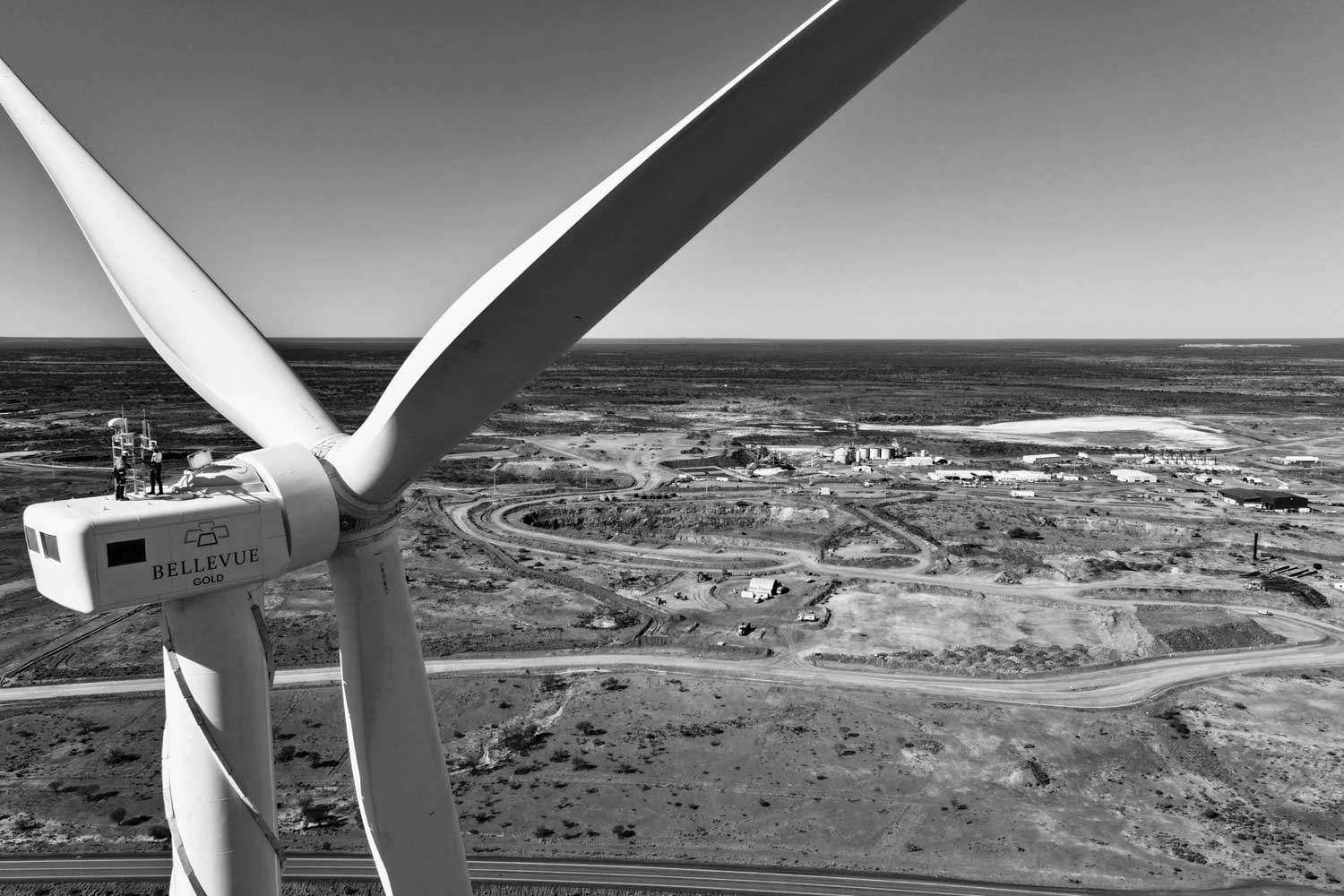
In Western Australia's Northern Goldfields, a gold mine that closed in the 1990s is running again – with 27 megawatts of solar and 24 megawatts of wind power on site. The Bellevue gold mine poured its first new gold in October 2023, and in its 2026 financial year it produced a record 143,539 ounces while cutting its greenhouse gas emissions by almost half. Its operator publishes how it mines, and Bellevue is one of the mines our Single Mine Origin Gold comes from.
Key insights
- Bellevue is an underground gold mine in Western Australia. It produced around 800,000 ounces until the 1990s, lay idle for two decades and has produced again since October 2023.
- Solar and wind supply most of its electricity. In the 2026 financial year, renewables covered 83.5 % of the mine's power, up from about 43 % a year earlier, according to Bellevue Gold.
- Emissions fell by almost half in one year. Scope 1 and 2 emissions dropped by 47 % in the 2026 financial year, while gold production rose by 14 %.
- The mine lies on Tjiwarl Country. A Native Title Agreement from 2022 covers heritage, land and water management, employment and contracting.
- Bellevue gold reaches Europe as Single Mine Origin (SMO) gold. It is refined separately under independent audit, and Fairever has offered it as gold bars since early 2026.
Table of contents
- Bellevue at a glance
- A mine that closed and came back
- How is gold mined at the Bellevue gold mine?
- Sun, wind and a battery in the Goldfields
- Net zero at the Bellevue gold mine
- Water, tailings and land at Bellevue
- On Tjiwarl Country
- People and safety at the mine
- Why Bellevue gold is responsible gold
- Bellevue gold: from Australia to Europe
- FAQs: The Bellevue gold mine, Australia
- Key takeaways
- Sources
Bellevue at a glance
| Name | Bellevue Gold Project (Bellevue), operated by Bellevue Gold Limited |
| Location | About 40 km north-west of Leinster, Northern Goldfields, Western Australia; on Tjiwarl native title land1 |
| Type | Large-scale underground gold mine |
| Organization | Listed company (ASX: BGL) |
| Established | Gold production since the early 1900s; modern mine 1986–1997; first gold of the new operation on October 25, 2023234 |
| Workforce | About 235 employees and 660 contractors (June 2026)1 |
| Production | 143,539 oz in the 2026 financial year (July 2025 – June 2026), about 4.5 t or 370 kg a month56 |
| Mining method | Underground stoping in five mining areas5 |
| Processing | Gravity and carbon-in-leach (CIL) with cyanide; plant capacity of 1.35 million tonnes of ore a year (1.16 million tonnes processed in the 2026 financial year); 95.5 % recovery785 |
| Certification / verification | SMO member mine since 2024; segregated refining under independent audit; annual sustainability report with independent assurance of key climate data91 |
| Status | Producing (September 2026) |
| Relevance | One of the sources of Fairever's SMO gold bars since early 202610 |
A mine that closed and came back
A century of gold, then silence
Bellevue is one of the old mines of the Goldfields. Gold has been produced here since the early 1900s, according to the state government.2 Between 1986 and 1997, an underground mine run by Plutonic took around 800,000 ounces out of the ground, at around 15 grams per tonne.113
At around 430 meters depth, the mine shut down. Gold prices were low, and geologists believed a fault, the Highway Shear, had cut off the ore.1112 For 20 years, the old tunnels served only to drain water for a neighboring nickel mine.11
Rediscovery and first gold in October 2023
In 2017, the first systematic exploration in two decades began. Steve Parsons and Michael Naylor joined the small company that became Bellevue Gold in early 2017.1213 At the new Viago lode, it took four months from the first discovery holes to a resource estimate. In October 2018, less than a year after drilling began, the company reported a resource of more than one million ounces.14
On October 25, 2023, the Bellevue gold mine poured its first new bar: 8.3 kilograms.4 Darren Stralow, Managing Director since March 2023, called it "the culmination of an incredible journey which started with an exploration project."4 In March 2024, the company officially opened the 252-million-Australian-dollar project.2
How is gold mined at the Bellevue gold mine?
Underground, not open pit
Bellevue mines underground, in five long-term mining areas.5 Most large-scale gold comes from open pits processing ore at around 1.05 grams per tonne.15 Bellevue's processed ore averaged 4.0 grams per tonne in the 2026 financial year.5 Less rock per ounce means less energy, water and waste, and far less land disturbed at the surface.
How carbon-in-leach works
Carbon-in-leach (CIL) dissolves gold in a dilute cyanide solution and catches it on activated carbon – in the same tanks. At Bellevue, the ore is crushed in three stages and ground; a gravity circuit first recovers the coarse gold.1 The rest flows as a slurry through leach tanks, where the cyanide dissolves the fine gold.
Activated carbon captures the dissolved gold – typically more than 99.5 % of it within 8 to 24 hours, according to the International Cyanide Management Institute.16 The gold is then stripped from the carbon and poured into bars; the leftover slurry goes to the tailings facility. At Bellevue, the process recovered 95.5 % of the gold in the 2026 financial year.5 No mercury is used: SMO member mines are mercury-free in extraction.17
Cyanide and mercury: not the same risk
Cyanide is acutely toxic, but it breaks down; mercury does not. "Under aerobic conditions, microbial activity can degrade cyanide to ammonia, which then oxidizes to nitrate," the cyanide institute explains.16 Mercury persists in the environment and accumulates in ecosystems, which is why the Minamata Convention restricts it worldwide.18
Handled properly, cyanide is part of the solution; Bellevue Gold reports "stringent protocols" for it.1 More in our article on gold mining's environmental impact.
Sun, wind and a battery in the Goldfields
A 90-megawatt hybrid power station
Bellevue has no grid connection, so it makes its own electricity – most of it from solar and wind. Zenith Energy built and operates the hybrid power station under a 15-year power purchase agreement; it has run commercially since May 2024.191 Its components:1
- Solar: 27 megawatts from 47,680 panels.
- Wind: 24 megawatts from four 6-megawatt turbines, each 212 meters tall.19
- Battery: 15 megawatts, with 30 megawatt-hours of storage.
- Gas and diesel: 15 megawatts of gas and 9 megawatts of diesel.
According to Zenith, the partnership also advances Tjiwarl Katu Power, a joint venture with a Tjiwarl-owned company.19 In 2023, Darren Stralow set the goal:
"The high utilisation of renewable energy in the power station and the flexibility to time-shifting activities with renewable energy availability is central to our goal to be Australia's first net-zero gold producer."
– Darren Stralow, Managing Director, Bellevue Gold, May 202320
From 43 % to 83.5 % renewable
Within one year, the renewable share almost doubled. In the 2025 financial year, before the wind turbines were fully running, renewables supplied about 43 % of Bellevue's electricity. In the 2026 financial year, it was 83.5 %, according to Bellevue Gold – with a monthly record of 93.8 % in February 2026 and a low of 70 % in the Australian winter.1
On sunny, windy days, the engines switch off entirely – in the 2026 financial year for a record 155 consecutive hours, more than six and a half days.1
"We believe that Bellevue Gold is absolutely world-leading in its decarbonisation of gold mining and this is providing an incredibly exciting new source of gold."
– Charlie Betts, Co-Founder, SMO Gold, 202621
What comes next: the diesel fleet
The remaining emissions come from burning diesel and gas. In the 2026 financial year, 63.9 % of Bellevue's emissions came from diesel and 35.4 % from liquefied natural gas; the company names underground mining equipment as the hardest part to electrify.1 Diesel accounted for only 1.5 % of project costs, which kept Bellevue less exposed than its peers when fuel prices rose in 2026, the company says.1
Bellevue already runs ventilation on demand for its underground fans and has tested a diesel-electric underground truck. Its planned path leads via hybrid to battery-electric vehicles; storage for surplus renewable power and renewable diesel are also under review.1
Net zero at the Bellevue gold mine
What does "net zero" mean at Bellevue?
Bellevue Gold states that it achieved net zero greenhouse gas emissions (Scope 1 and Scope 2) at the Bellevue Gold Project in calendar year 2025 and maintained it in the 2026 financial year.1 According to the company, this rests on on-site renewable energy and emission reduction, renewable energy certificates, and voluntarily purchased Australian Carbon Credit Units (ACCUs) that offset the remaining hard-to-abate emissions.1
For 2025, Bellevue reports 33,646 tonnes of CO₂e, offset by 33,646 carbon credits, plus 72,701 surrendered renewable energy certificates; EY gave these figures reasonable assurance. For the 2026 financial year, it reports 25,976 tonnes, offset in the same way.1 The claim covers only on-site emissions; Scope 3, for example from transport, supplies or refining, is not included.1
The surrenders can be checked in public registers. In the registers of Australia's Clean Energy Regulator, we found exactly 72,701 certificates from the power station's 2025 output surrendered and 33,646 carbon credits cancelled by Golden Spur Resources, which holds Bellevue's mining leases.22232425
Management's pay was tied to the goal. In 2021, shareholders approved sustainability performance rights for staff that would vest in full only once an independent assurance provider had confirmed net zero at the mine.1 For the managing director and the chief financial officer, they vested at 100 % in the 2026 financial year. Executives' annual bonuses also depend on safety (25 %) and ESG targets (10 %), such as more than 30 % women and above-average Indigenous employment.8
Excursus: how strong are savanna fire credits?
Bellevue uses only credits from savanna fire management – among the more credible types of Australian carbon credit, with clear limits. The projects reintroduce controlled burning early in the dry season, when fires are cooler. That reduces the frequency and severity of late-season fires and the methane and nitrous oxide they release. The credits count the avoided emissions against a historical baseline.26
Much of this work is Indigenous-led. Indigenous projects account for 70 % of the area registered under the method and 74 % of the credits from its emissions avoidance version.27 Almost half of Bellevue's 2025 credits came from the fire projects of Dambimangari, Wilinggin and Wunambal Gaambera Uunguu – north Kimberley native title groups that in 2014 became the first Indigenous groups in Australia to register carbon businesses on their lands.12829
Why they are considered credible: the debate about the integrity of Australian carbon credits – raised by researchers at the Australian National University and examined in a government-commissioned review in 2022 – centered on other methods, such as human-induced regeneration, landfill gas and avoided clearing.3031 New savanna methods introduced in April 2026 were assessed by the scheme's independent Emissions Reduction Assurance Committee as meeting the legislated integrity standards.32 The market pays for that: in 2024, savanna credits with Indigenous co-benefits traded at 50 Australian dollars, against a generic average of around 33.33
Where the limits are: these are avoidance credits, not removals. They prevent emissions elsewhere but do not take carbon out of the atmosphere, and the Oxford Offsetting Principles call for residual emissions to be balanced with durable removals over time.34 No Australian credit method carries the Core Carbon Principles label of the Integrity Council for the Voluntary Carbon Market.35 Bellevue is exploring the next step with the Tjiwarl Aboriginal Corporation: mineral carbonation, in which CO₂ reacts with calcium- and magnesium-rich minerals in tailings or waste rock and is stored permanently.1
One rule applies regardless of quality. Since September 27, 2026, EU law prohibits claiming that a product is climate-neutral on the basis of offsets.36 That is why we describe net zero as what it is – a statement by the operator about emissions at its mine – and not as a property of the gold.
How do Bellevue's emissions compare?
Before offsets, Bellevue emitted 0.27 tonnes of CO₂e per ounce in 2025 and 0.18 tonnes in the 2026 financial year.1 In Bellevue's own comparison of major Australian gold mines, based on public data, the other mines ranged from 0.35 to 2.10 tonnes per ounce, which makes Bellevue the lowest of the group.1
Independent studies give an Australian average of 0.637 tonnes and a global average of 0.726 (2018 data), and around 0.40 tonnes for underground mines worldwide (2019).3715 A newer industry average points the same way: in 2025, 18 major gold miners emitted 0.9 tonnes of CO₂ per gold-equivalent ounce, according to the consultancy Metals Focus.38 At 0.18 to 0.27 tonnes, Bellevue sits below all of these averages.
Water, tailings and land at Bellevue
Like other gold mines in the Goldfields, Bellevue processes its ore with hypersaline groundwater. Saline to hypersaline groundwater has long been the standard water source for gold processing in the region; the Super Pit in Kalgoorlie covers around 80 % of its needs with saline or recycled water.3940 At Bellevue, the salty water is pumped out of the underground mine anyway, then used and recycled through the plant, the tailings facility and processing ponds.1
Fresh water use is correspondingly low: 87,859 kiloliters in the 2026 financial year, or about 0.6 kiloliters per ounce of gold.141 It comes from a separate bore field, is treated by reverse osmosis and used mainly in the accommodation village and parts of the plant. Bellevue developed its groundwater strategy with input from the Tjiwarl Aboriginal Corporation's Water Management Group.1
Since October 2024, tailings have gone to an integrated waste landform, built together with waste rock and designed in accordance with Australian dam safety guidelines; monitoring bores and sensors watch for seepage.1 A paste plant is due for completion in December 2026; it will send around 25 % of the tailings back underground as backfill.1 Bellevue is also working with the Tjiwarl Native Title Holders on options to rehabilitate a tailings facility left by the previous operator.1
No threatened plants have been recorded on the tenements, and a bird and bat management plan addresses the wind turbines.142 Water was also behind two publicly documented incidents. Between December 2019 and March 2020, hypersaline water overflowed from a pit through a vent shaft and affected about 16 hectares of native vegetation; in 2023, a court fined the company 41,000 Australian dollars.43 In July 2024, hypersaline water seeped from a pit onto 591 square meters and into the fringes of Lake Miranda; the regulator required an interception trench and monitoring.44
On Tjiwarl Country
Bellevue lies on the land of the Tjiwarl people, whose native title the Federal Court of Australia recognized in April 2017.45 The determination covers around 13,600 square kilometers between Wiluna and Leonora; "Tjiwarl" means "something shining."46 The native title holders belong to 11 families.47
In 2022, Bellevue and the Tjiwarl Aboriginal Corporation signed a Native Title Agreement. It covers land and water management, Aboriginal heritage management, cultural awareness and access, social opportunities, employment and contracting, and compensation.47
"It has been a long process to get to where we are today. Tjiwarl native title holders worked hard to make sure culture and heritage is protected and managed the best way possible."
– Brett Lewis, Chairperson, Tjiwarl Aboriginal Corporation, October 202247
The agreement shapes daily work on site. A cultural heritage management plan, guided by free, prior and informed consent, applies, and Tjiwarl representatives regularly monitor heritage on site. The Tjiwarl Parna Committee, 22 members representing the 11 family groups, met twice in the 2026 financial year to discuss the life-of-mine plan and visited the site twice.1 A Tjiwarl employment and contracting plan includes traineeships.1
Views within the community are not uniform. In 2024, a Tjiwarl Elder applied for federal heritage protection of Lake Miranda, arguing that drilling beneath the lake would interrupt a Dreaming pathway.48 Bellevue says it has the Tjiwarl native title group's permission under its heritage management plan.49 The application was still under ministerial consideration in September 2025.50
People and safety at the mine
Bellevue employs a far more diverse workforce than most mines. On SMO's ESG benchmark, it ranks as the world's most gender-diverse gold mine, ahead of CC&V in the USA and San José in Mexico, the company reports.1
| Metric (June 2026) | Bellevue | Australian mining | Global mining |
|---|---|---|---|
| Women in the workforce | 31.5 %1 | 23 %51 | around 15 %52 |
| Women in leadership | 34.1 %1 | 22 % of managers51 | around 12 % of executive roles53 |
| Gender pay gap | 12.2 %1 | 18.9 %54 | – |
| Aboriginal employees | 6.8 %1 | 5.6 % (WA resources sector)55 | – |
Behind these numbers are traineeships for young Aboriginal women and men with the Shooting Stars and Clontarf foundations, trainee roles for women in processing and 20 weeks of paid parental leave for primary carers.1
Bellevue reported no fatalities in the 2024 to 2026 financial years.1 Recordable injuries rose in the 2026 financial year; Bellevue says it "did not meet all of our health and safety goals" and has integrated its safety systems with a new underground mining contractor. Its mine safety management system is aligned with ISO 45001, and Bellevue is recognized as a Gold Mental Health First Aid Skilled Workplace.1
Why Bellevue gold is responsible gold
Gold from Bellevue is responsible gold in three specific ways: it is traceable to this one named mine through an externally audited chain of custody; its producer publishes environmental and social data with independent assurance of its key climate figures; and the mine covers 83.5 % of its power with solar and wind, relies mainly on hypersaline rather than fresh water for processing and manages heritage under an agreement with the Traditional Owners.
Australia as a mining location
Bellevue operates in Western Australia, within a comparatively strong legal framework. Among the 13 largest gold-producing countries listed by the US Geological Survey, Australia scores highest in Transparency International's 2025 Corruption Perceptions Index, with 76 of 100.5657
Mine closure is regulated from the start. Since September 2025, all mining activities in Western Australia have required an approved mining development and closure proposal before they begin.58 Most operators also pay into a pooled Mining Rehabilitation Fund, which the state can use to rehabilitate abandoned mines.59 A review by the International Institute for Sustainable Development counts Australia among the "global leading-practice players" in mine closure.52
Western Australia's Work Health and Safety Act and its regulations for mines have applied since March 2022; they include the offense of industrial manslaughter for companies and officers whose breach of duty causes a death.60 Australia does not appear, with any good, on the US Department of Labor's 2024 list of goods produced with child or forced labor; gold from Ghana, Peru and Indonesia, for example, does.61
The framework has limits. Australia has not ratified the ILO's Indigenous and Tribal Peoples Convention (No. 169), which Peru, Mexico, Brazil and Colombia, for example, have.62 A strong national framework is therefore a floor, not proof: what makes gold traceable is the mine, not the country.
A named mine and an audited chain
Every batch of Single Mine Origin gold is traceable to one named mine. Bellevue's gold is refined separately at an LBMA-accredited refinery in Australia, overseen by an independent auditor, Bureau Veritas.91710
SMO itself holds a Chain of Custody certification from the Responsible Jewellery Council.9 More: traceable gold.
Data you can check yourself
Bellevue Gold publishes an annual sustainability report, aligned with GRI and SASB, and since the 2026 financial year a climate report under Australia's mandatory standard AASB S2, with limited assurance of its Scope 1 and 2 emissions by EY.1 Bellevue is a signatory to the UN Global Compact and was added to the Dow Jones Best-in-Class Australia Index in 2026.1 In large-scale gold mining, much assurance is self-assurance, as we explain in our article on responsible large-scale gold mining. At Bellevue, anyone can compare the numbers year by year:
| What changed in one year | 2025 financial year | 2026 financial year |
|---|---|---|
| Gold production | 126,139 oz7 | 143,539 oz5 |
| Renewable share of electricity | 43 % | 83.5 % |
| Scope 1 and 2 emissions | 49,257 t CO₂e | 26,022 t CO₂e |
| Emissions per ounce (before offsets) | 0.39 t CO₂e | 0.18 t CO₂e |
| Longest run on renewables alone | 58 hours42 | 155 hours |
| Net zero statement | first half of 2025, without external assurance42 | calendar year 2025 and 2026 financial year, assured by EY |
| Fresh water withdrawn | 71,383 kL | 87,859 kL |
| Tailings produced | 1,088,441 t | 1,157,959 t |
| Total recordable injury frequency rate* | 6.8 | 14.4 |
* Recordable injuries, with and without lost time, per one million hours worked, for employees and contractors. Unless noted otherwise: Bellevue Gold, Sustainability Report 2026.1
What the juries saw
In 2025, Bellevue won three Australian awards for its environmental and ESG performance. The mining association AMEC gave it its Environment Award: "After setting the ambitious target of net zero emissions by 2026, Bellevue achieved its goal ahead of schedule and are currently Australia's most renewably powered mining operation."63
At the Decarbonising Mining Awards, Bellevue received the recognition for "Excellence in ESG by a Mining Company," for "its comprehensive and transformational ESG framework, including strong Traditional Owner partnerships and ambitious climate commitments."64 The AIM WA Pinnacle Awards honored it for Environmental Sustainability Excellence; the jury cited its hybrid power station "featuring wind, solar, and battery storage" and its work "advancing Indigenous partnerships and workforce diversity across its operations."65
Bellevue gold: from Australia to Europe
Bellevue joined SMO in 2024 as its first member mine outside Africa.942 SMO has been wholly owned by the Betts Group since 2024.9 The Paris jeweler Messika became the first fine jewelry house in the world to use Bellevue gold, according to Bellevue; SMO gives it, in Valérie Messika's words, "the assurances required on responsibility, traceability and transparency."1 At the launch of the SMO Foundation at London's Natural History Museum in 2025, a film prominently featured Bellevue's operations.166
In February 2026, Charlie Betts visited the mine with jewelers and manufacturers from the UK, the USA, Thailand and Australia; the visit began with a Welcome to Country recognizing the Tjiwarl Traditional Owners.1 In the same month, Betts, in his words "the UK's supplier of SMO Gold," delivered its first Bellevue gold grain to a UK jeweler.67
"Bellevue is a testament to what can be achieved with an ambitious and committed approach to reducing the carbon emissions associated with gold mining."
– Charlie Betts, Managing Director, The Betts Group, February 202667
Fairever is the partner of the Betts Group and SMO for continental Europe. Since early 2026, we have offered Bellevue gold as SMO gold bars.10 Betts also sees SMO as an answer to the recycling debate:
"To date, the jewellery industry has largely relied on promoting recycled gold as the lowest emission option for precious metal. However, this is fraught with misconceptions and often such carbon reduction claims cannot be substantiated."
– Charlie Betts, Managing Director, The Betts Group, February 202667
We agree, as we explain in why regular recycled gold is not a solution.
FAQs: The Bellevue gold mine, Australia
Where is the Bellevue gold mine in Australia?
The Bellevue gold mine lies about 40 kilometers north-west of Leinster in the Northern Goldfields of Western Australia, on Tjiwarl Country. It is an underground mine operated by the listed company Bellevue Gold Limited.
Does Bellevue use mercury or cyanide?
No mercury. Bellevue recovers gold by gravity and carbon-in-leach with dilute cyanide, which, unlike mercury, breaks down in the environment.
How much renewable energy does Bellevue use?
According to Bellevue Gold, renewables covered 83.5 % of the mine's electricity in the 2026 financial year, up from about 43 % a year earlier. Its off-grid power station combines solar, wind and a battery with gas and diesel generators.
Is Bellevue a net zero gold mine?
Bellevue Gold states that it achieved net zero greenhouse gas emissions (Scope 1 and Scope 2) at the project in 2025 and in its 2026 financial year, through on-site renewables, renewable energy certificates and purchased Australian carbon credits; EY assured the 2025 figures. Scope 3 emissions are not included.
Which carbon credits does Bellevue use?
Only Australian Carbon Credit Units from savanna fire management projects in northern Australia, many of them run by Indigenous groups. They are avoidance credits rather than removals; Bellevue is exploring carbon storage in mine waste as a next step.
Can I buy Bellevue gold in Europe?
Yes. Fairever, partner of the Betts Group and SMO for continental Europe, offers Single Mine Origin gold bars made from Bellevue gold.
Key takeaways
In a nutshell ...
- Solar and wind now carry most of the load. Renewable power at the Bellevue gold mine rose from about 43 % to 83.5 % within a year, and emissions per ounce fell from 0.39 to 0.18 tonnes before offsets.
- Australian savanna fire credits offset the remaining emissions at the mine. On that basis, Bellevue Gold states that it achieved net zero for Scope 1 and 2 in 2025 and in the 2026 financial year; Scope 3 is not included.
- The social side stands out too. Bellevue works under a Native Title Agreement with the Tjiwarl people, and women make up almost a third of its workforce, against 23 % in Australian mining.
- Transparency is the strongest argument. Bellevue Gold publishes energy, water, safety and workforce data, has its climate figures assured, and its offsets can be traced in public registers.
- Ask for the mine, not just the category. Only gold traceable to a named mine tells you where it comes from – so ask your supplier which mine yours comes from.
Get active, be the change!
Bellevue gold is available from us as cast gold bars. Want gold from a mine you can name? Take a look at our SMO gold bars – or get in touch, and we will tell you more about Bellevue.
Further reading
- What Bellevue gold means for your products and claims: SMO gold from the Bellevue mine.
- The sourcing model behind it: What is Single Mine Origin (SMO)?
- The wider industry, from methods to impacts: large-scale gold mining.
Sources
- Bellevue Gold, Sustainability Report 2026, September 2026, pp. 4–9, 12–61, 66–77, including the CY25 Bellevue Gold Project – GHG Accounting & Offsetting Report with EY's independent reasonable assurance report, and the Climate Report with EY's review report. Reporting period July 1, 2025 – June 30, 2026. ↩ ↩ ↩ ↩ ↩ ↩ ↩ ↩ ↩ ↩ ↩ ↩ ↩ ↩ ↩ ↩ ↩ ↩ ↩ ↩ ↩ ↩ ↩ ↩ ↩ ↩ ↩ ↩ ↩ ↩ ↩ ↩ ↩ ↩ ↩ ↩ ↩ ↩ ↩ ↩ ↩ ↩ ↩ ↩
- Government of Western Australia, Reborn mine reinforces WA's golden heritage, media statement, March 13, 2024. ↩ ↩ ↩
- Bellevue Gold, Stage One Feasibility Study, ASX, February 18, 2021, p. 15. Bellevue's website gives 11 grams per tonne and 1996 as the year of closure (footnote 11); we follow the company's ASX filings. ↩ ↩
- Bellevue Gold, First gold poured at Bellevue Gold Project, ASX, October 26, 2023, pp. 1–2. ↩ ↩ ↩
- Bellevue Gold, Quarterly report for the June 2026 quarter, ASX, July 28, 2026, pp. 1–7, 11 and 14. ↩ ↩ ↩ ↩ ↩ ↩ ↩
- Fairever calculation: 143,539 oz (footnote 5) ÷ 32.1507 oz per kg ≈ 4,465 kg ≈ 4.5 t; 4,465 kg ÷ 12 ≈ 372 kg a month, rounded to 370 kg. ↩
- Bellevue Gold, Annual Report 2025, ASX, August 28, 2025, pp. 10–13. ↩ ↩
- Bellevue Gold, Annual Report 2026, September 2026, pp. 12–13, 46–47 and 50–51. ↩ ↩
- SMO Gold, About us, accessed September 2026. ↩ ↩ ↩ ↩ ↩
- Fairever, internal information, September 2026. ↩ ↩ ↩
- Bellevue Gold, Bellevue Gold Project, accessed September 2026. ↩ ↩ ↩
- Draig Resources (today Bellevue Gold), Quarterly report for the March 2018 quarter, ASX, April 20, 2018, p. 3. ↩ ↩
- Bellevue Gold, Quarterly report for the December 2025 quarter, ASX, January 20, 2026, pp. 2, 9–13. ↩
- Bellevue Gold, Bellevue Resource More than 1 Million Ounces of Gold, ASX, October 22, 2018, p. 1. ↩
- S&P Global Market Intelligence, Greenhouse gas and gold mines: Nearly 1 tonne of CO2 equivalent emitted per ounce of gold produced in 2019, reference year 2019. Open-pit mines emitted around 0.85 t CO₂e per ounce, underground mines less than half of that. ↩ ↩
- International Cyanide Management Institute, Cyanide Facts, accessed September 2026. ↩ ↩
- SMO Gold, SMO Gold Introduction Brochure, 2026. ↩ ↩
- United Nations Environment Programme, Minamata Convention on Mercury, 2013, preamble. ↩
- Zenith Energy, Bellevue Gold, project page, accessed September 2026. Zenith gives slightly more precise capacities (89.7 MW in total, 26.6 MW solar, 14.9 MW / 30 MWh battery); the text follows Bellevue's rounded figures (footnote 1). ↩ ↩ ↩
- Bellevue Gold, Bellevue signs hybrid power agreement, paving way for net-zero gold production, ASX, May 25, 2023, p. 1. ↩
- SMO Gold, Bellevue becomes the world's first net zero gold mine, undated (2026), accessed September 2026. ↩
- Clean Energy Regulator, REC Registry, Register of large-scale generation certificates, search by accreditation code SRPVWAM4 ("Bellevue Gold – Solar and Wind – WA"), accessed September 27, 2026. ↩
- Clean Energy Regulator, Voluntary cancellations register, last updated September 24, 2026, accessed September 27, 2026. ↩
- Environmental Protection Authority, Western Australia, Bellevue Gold Project – referral supporting information, May 2020: mining leases M36/24 and M36/25 "held by Golden Spur Resources Pty Ltd". ↩
- Fairever research and calculation. LGC register (footnote 22): certificates from 2025 generation with the status "invalid due to voluntary surrender", 31,861 (solar) + 40,840 (wind) = 72,701. Voluntary cancellations register (footnote 23), entity Golden Spur Resources Pty Ltd: 1 (November 19, 2025) + 22,701 (November 28, 2025) + 5,838 (December 8, 2025) + 3,995 (December 21, 2025) + 1,111 (February 18, 2026) = 33,646 units. ↩
- Clean Energy Regulator, Savanna fire management methods, accessed September 2026. ↩
- Clean Energy Regulator, Traditional knowledge and modern science combine to reduce emissions, case study, last updated June 12, 2024. ↩
- Kimberley Land Council, Savanna burning carbon projects, accessed September 2026. ↩
- Fairever calculation from footnote 1, Table 3: 5,000 (Dambimangari) + 5,000 (Wilinggin) + 5,000 (Wunambal Gaambera Uunguu) = 15,000 of 33,646 ACCUs surrendered for 2025 ≈ 45 %. The remaining credits came from the Wongalara and North Kimberley Pastoral Lease savanna projects. ↩
- Macintosh et al., Australian National University, Analysis of the report of the Independent Review of Australian Carbon Credit Units, February 15, 2023. ↩
- Independent Review of ACCUs (Chubb Review), Independent Review of Australian Carbon Credit Units – Final Report, December 2022. ↩
- Department of Climate Change, Energy, the Environment and Water, Update on ACCU savanna fire management methods, April 10, 2026, as published by Mirage News. ↩
- Clean Energy Regulator, Quarterly Carbon Market Report – June Quarter 2024: Australian carbon credit units, 2024. ↩
- Smith School of Enterprise and the Environment, University of Oxford, The Oxford Offsetting Principles, revised edition February 2024. ↩
- Integrity Council for the Voluntary Carbon Market, Assessment status, updated September 4, 2026, accessed September 2026. The ACCU scheme is not listed as CCP-eligible or under assessment. ↩
- European Union, Directive (EU) 2024/825 on empowering consumers for the green transition, February 28, 2024, Annex I point 4c and recital 12; applicable from September 27, 2026 (Article 4). ↩
- Ulrich, Trench & Hagemann, Gold mining greenhouse gas emissions, abatement measures, and the impact of a carbon price, Journal of Cleaner Production 340, 2022. Scope 1 and 2, 194 mines in 35 countries, 2018 data. ↩
- Mining Weekly, Gold miners showing commitment to achieving ESG targets, says consultancy, September 21, 2026, reporting on Metals Focus, Gold ESG Focus 2026 (18 major gold miners, 2025 data). ↩
- Johnson, Commander & O'Boy, Groundwater Resources of the Northern Goldfields, Western Australia, Water and Rivers Commission, Hydrogeological Record Series HG 2, 1999. ↩
- Kalgoorlie Consolidated Gold Mines, Water and tailings, accessed September 2026: "80% saline groundwater or water recovered and recycled from operations". ↩
- Fairever calculation: 87,859 kL fresh water withdrawn (footnote 1, ESG summary table) ÷ 143,539 oz (footnote 5) ≈ 0.61 kL per ounce. The report's narrative gives 158,558 kL of potable groundwater and 851,382 kL of hypersaline groundwater; the table, following GRI 303-3, gives 87,859 kL of fresh water and 2,697,468 kL of other water including mine dewatering. We use the table values. ↩
- Bellevue Gold, Sustainability Report 2025, ASX, August 28, 2025, pp. 2–5, 22–23 and 28–29. Reporting period July 1, 2024 – June 30, 2025. ↩ ↩ ↩ ↩
- Government of Western Australia, Gold miner fined for hypersaline spill, April 28, 2023. Fines of 31,000 and 10,000 Australian dollars, imposed by the Perth Magistrates Court on April 27, 2023. ↩
- Department of Water and Environmental Regulation, Western Australia, Amendment report, licence L9259/2020/1, November 26, 2024, pp. 12–13 and 29–30. ↩
- Tjiwarl Aboriginal Corporation, What we do, accessed September 2026. ↩
- Central Desert Native Title Services, Tjiwarl, accessed September 2026. ↩
- Bellevue Gold, Bellevue signs Native Title Agreement with Tjiwarl Aboriginal Corporation, ASX, October 3, 2022. ↩ ↩ ↩
- Commonwealth of Australia, Notice of an application for the protection of a specified area, being the area known as Lake Miranda, Western Australia, August 15, 2024, under section 10 of the Aboriginal and Torres Strait Islander Heritage Protection Act 1984. ↩
- Melanie Burton, Australian mine fight reignites Aboriginal heritage tensions, Reuters, via Mining.com, October 1, 2024. ↩
- Ashurst, Commonwealth cultural heritage protection applications: still top of mind for First Nations Groups, September 9, 2025. ↩
- Workplace Gender Equality Agency, Gender Equality Scorecard 2024-25, November 2025. Private employers with 100 or more staff. ↩ ↩
- International Institute for Sustainable Development (IISD) and Intergovernmental Forum on Mining, Minerals, Metals and Sustainable Development (IGF), Global Review: Financial assurance governance for the post-mining transition, 2021, p. 10. ↩ ↩
- McKinsey & Company, Increasing diversity in mining: three years on, November 10, 2023 (C-suite positions at more than 2,000 publicly traded mining companies). ↩
- Workplace Gender Equality Agency, Employer Gender Pay Gaps Report 2024-25, March 2026: mining industry mid-point, average total remuneration. Bellevue's report cites 19.8 %, the value for 2023-24. ↩
- Chamber of Minerals and Energy of Western Australia, Diversity & Inclusion Report, 2025 (survey of member companies, 2023 data, including oil and gas). ↩
- U.S. Geological Survey, Mineral Commodity Summaries 2026: Gold, 2026, world mine production 2025 (estimates). ↩
- Transparency International, Corruption Perceptions Index 2025, February 2026, and country page Australia, accessed September 2026. Of the 13 countries in footnote 56, Canada follows with 75 and the United States with 64; the other ten score 43 or lower. ↩
- Government of Western Australia, Department of Mines, Petroleum and Exploration, Mining Development and Closure Proposals, last updated September 24, 2026. ↩
- Government of Western Australia, Department of Mines, Petroleum and Exploration, About the Mining Rehabilitation Fund, last updated November 7, 2025. Most tenements covered by State Agreements do not contribute. ↩
- WorkSafe Western Australia, Work health and safety laws, last updated December 6, 2024. ↩
- U.S. Department of Labor, Bureau of International Labor Affairs, 2024 List of Goods Produced by Child Labor or Forced Labor, September 2024. ↩
- International Labour Organization, NORMLEX, Ratifications of C169 – Indigenous and Tribal Peoples Convention, 1989 (No. 169), accessed September 2026. ↩
- Association of Mining and Exploration Companies, 2025 AMEC Awards celebrate the best of Australia's exploration and mining industry, December 6, 2025. ↩
- PR Newswire, Winners Announced for the 2025 Decarbonising Mining Awards, May 7, 2025. The category is listed as "Excellence in ESG by a Mining Company (Recognition of Excellence)". ↩
- AIM WA Pinnacle Awards, Who are the winners, 2025 winners announced November 19, 2025, accessed September 2026. ↩
- May Garland, SMO Gold raises over $250,000 to launch new charity at Natural History Museum Gala, Retail Jeweller, July 7, 2025. ↩
- Harriet Whitaker, The Betts Group supplies inaugural gold from net-zero mine, Professional Jeweller, February 12, 2026. ↩ ↩ ↩