
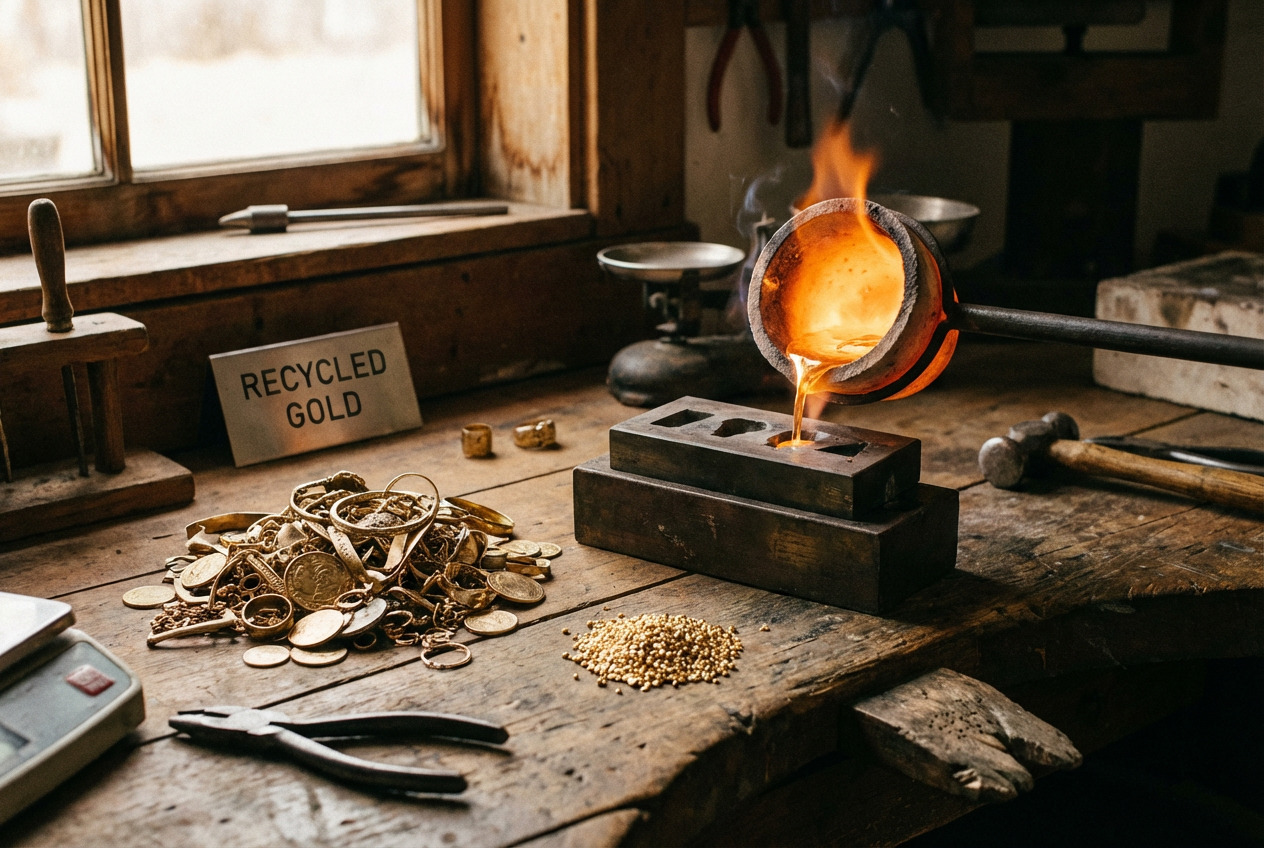
Recycled gold sounds sustainable. But does it deliver on that promise? Not always – because the term conceals very different materials with entirely different effects.
Key Takeaways
- Recycled gold is not a protected term. Without clear standards, it can range from genuine end-of-life jewelry to freshly mined gold. The differences are enormous.
- Conventional recycled gold fails to answer five key questions: Where does it really come from? Under what conditions was it mined? Does it actually reduce mining? Does it have social impact? Is it really more climate-friendly?
- The source is what matters. Post-consumer gold (from end users) closes the loop. Pre-consumer material (production waste) and investment gold (melted-down bars) do not.
- Standards provide clarity. RJC Chain of Custody and SCS-103 offer the ability to distinguish between genuine post-consumer gold and other categories. So far, hardly anyone uses this.
- At Fairever, you are guaranteed post-consumer recycled gold. 100% from end users, tested to 999.9‰ purity, with no pre-consumer or investment material.
The 5 Most Important Questions About Recycled Gold
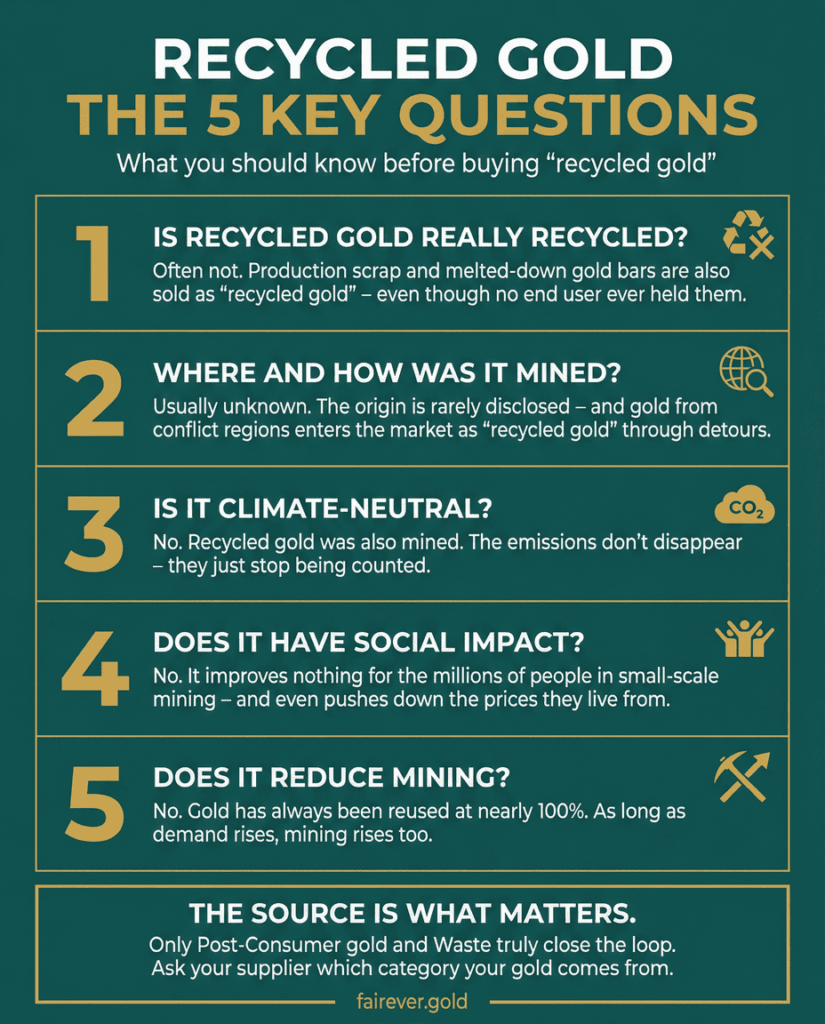
1. Is recycled gold really recycled?
The term “recycling” normally suggests that materials are being reused that are genuinely “waste” or “rubbish” and destined for final disposal, for example in a waste incineration plant or a landfill. In the gold market, however, the term is applied generously.
Recycled gold frequently consists of gold that could still be perfectly well used in its existing form, or with minimal effort.
Typical sources:
- Gold bars and coins
- Jewelry products
- Production waste from jewelry manufacturing
These are purchased by refineries, melted down, and marketed as “ethically sound,” “environmentally friendly,” and “climate neutral.”
The problem: Not all of it actually had a complete life as a product. Production waste from jewelry manufacturing – offcuts, filing dust, casting residues – is often also labeled as recycled gold.
It’s as if you rolled out cookie dough, cut out cookies, and then called the leftover dough scraps “recycled.” Nobody would use that word. With gold, it happens all the time.
2. Where and under what conditions was recycled gold mined?
Most dealers and refineries do not disclose the origin of recycled gold. Often the origin cannot even be determined, or worse, is deliberately concealed. Without knowing the origin, you have no way of knowing whether the gold comes from responsible sources.
In some cases, gold from illegal sources enters the regular precious metals trade via intermediaries and is sold as recycled gold.
Study: Gold from Dubai is often blood gold
An investigation by the Swiss NGO SWISSAID (2020) shows:
- A large proportion of recycled gold sold to Germany via Switzerland originates from the United Arab Emirates.
- Controls in Dubai on origin are demonstrably inadequate.
- Example: Gold from the Congo is imported via France, and then France is listed as the “country of origin.”
Conclusion of the study: Illegal gold from conflict regions enters the international gold trade without difficulty.
3. Is recycled gold climate-neutral and environmentally friendly?
Recycled gold is frequently marketed as particularly environmentally friendly. What is concealed: recycled gold was also mined – possibly just weeks ago. How and under what conditions that mining took place, nobody knows.
Was the gold mining ecologically and socially responsible? Nobody knows.
On top of that: gold has always been reused at a rate of nearly 100%. Gold is not plastic or cardboard. It is practically never thrown away. Calling recycled gold a “climate-friendly alternative” is therefore misleading: the gold would have been recycled anyway.
Two common arguments and why they don’t hold up:
Argument 1: “No long transport routes” The scrap gold used for recycled gold has the same transport history as newly mined gold. The difference: those transports happened at an earlier point in time. The environmental impact of those transports remains the same.
Argument 2: “Lower energy consumption” The technical processes in refineries have high energy consumption. The refining process itself (aqua regia, electrolysis) consumes a similar amount of energy – regardless of whether the gold comes from a mine or from end-of-life jewelry.
The decisive difference lies in what comes before: for mined gold, TONNES of rock must first be blasted, transported, and processed. This mining process accounts for over 99 percent of the CO2 footprint. With recycled gold, this step was already carried out in the past – but the emissions have not disappeared.
The result: on paper (if you ignore the emissions previously generated by mining), the CO2 footprint of recycled gold is approximately 30–50 kg per kilogram of gold. For mined gold, it is around 30,000 kg – 600 times as much.
However, this calculation only works if you set the emissions from the original mining to zero on paper (the so-called “cut-off approach”). The CO2 burden from mining does not vanish through refining – it simply stops being counted. And every reprocessing actually increases the total CO2 footprint of gold even further.
The key point: the use of recycled gold does not save any CO2, because recycling gold does not lead to less gold being mined. And that is precisely what makes the decisive difference between recycling gold and recycling other materials.

4. Does recycled gold have a social impact?
The use of recycled gold has no social impact. On the contrary: it negatively affects the living conditions of millions of miners.
Why?
Prices for recycled gold (almost always without proof of origin) are frequently below the regular market price for newly mined gold (with proof of origin). When more and more people prefer recycled gold, this creates price pressure on the entire gold market.
The consequence: Small-scale miners – both legal and illegal – receive low pay for their work. Their gold enters the regular market through illegal channels, only to be sold later as “sustainable” recycled gold.
The other side
Those who exclusively use recycled gold are withdrawing from responsibility for conditions in mining. The global community looks away. The people who depend on mining are offered no prospect of improvement. Their working conditions remain invisible – and with them, the chance for change.
5. Does recycled gold reduce gold mining?
Clear answer: No.
Demand for gold continues to rise every year. Yet the supply of scrap gold can barely be expanded, since virtually all “used” or “no longer wanted” gold is already being reused and practically no gold is thrown away.
The numbers speak for themselves:
- Currently, delivered “scrap gold” covers only about 23% of global gold demand.
- Gold mining has not been reduced in any way by recycled gold.
- As gold prices continue to rise, more and more low-income regions begin mining – often under precarious conditions.
Source: World Gold Council – Gold Demand Trends
The reason is simple: Gold demand is driven primarily by investors and the jewelry industry. Whether more or less material declared as “recycled gold” is used has hardly any influence on the amount newly mined. As long as demand rises, mining rises too.
The Problem: "Recycled Gold" Does Not Equal Recycled Gold
The answers to these five questions vary so widely because “recycled gold” is not a protected term. There is no standardized definition, no legal requirements, no binding standards.
The decisive difference lies in the source.
Does the gold come from end users – for example from end-of-life jewelry or electronic waste? Or does it come from production waste that never reached an end customer? Or from melted-down gold bars that came from a mine just last week?
The industry distinguishes four main categories:
- Investment: Melted-down gold bars and coins – does not count as genuine recycling, because it is far too easy for fresh material of unknown origin to be included.
- Pre-Consumer: Production waste from jewelry manufacturing that never reached an end customer – strictly speaking, not genuine “recycling” but an internal industrial material flow.
- Post-Consumer: Material from end users (e.g. jewelry, watches, ornaments, dental gold) at the end of the product lifecycle.
- Waste: Actual “rubbish” that enters the waste stream (e.g. electronic scrap, crucibles, industrial parts and products at the end of their useful life, low-grade material e.g. from waste incineration, sweepings).
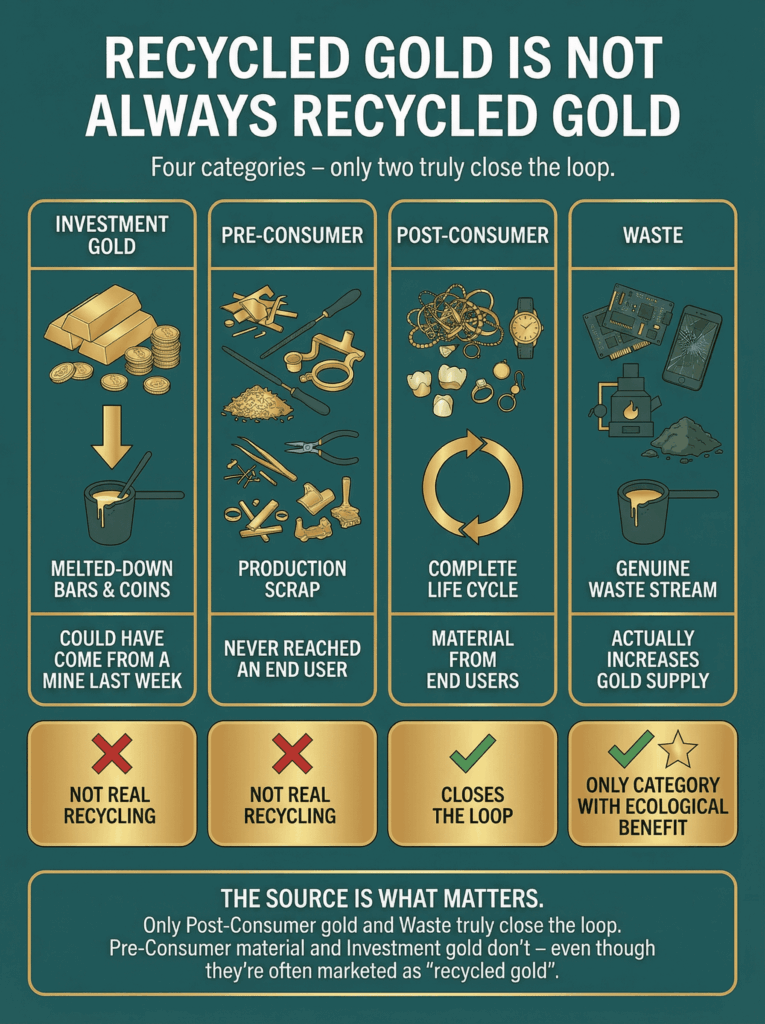
Only gold from post-consumer and waste recycling truly closes the loop. Pre-consumer and investment gold are strictly speaking not genuine recycling at all – even though they are frequently sold as “recycled gold.”
Without clear labeling, you do not know which category your gold falls into.
Want to know more?
What exactly distinguishes these categories, which ones create a genuine loop and which do not, and how to recognize them, we explain in detail in our article: Is Recycled Gold really Recycled?
The Solution: Clear Definitions and Transparency
To prevent “recycled gold” from becoming an empty marketing buzzword, what is needed are clear definitions and verifiable proof of origin.
Organizations such as the Responsible Jewellery Council (RJC CoC Standard) and SCS Global Services (SCS-103 Standard) are working to create this transparency. Their standards clearly distinguish between different recycling categories and require segregated supply chains, specific documentation, and independent auditing. However, in practice this distinction usually only takes place internally and is not communicated in a way that is transparent for customers (e.g. with percentages of the recycling categories contained).
The most important thing for you when purchasing: ask specifically what type of recycled gold you are getting! Is it post-consumer? Are pre-consumer and investment gold explicitly excluded? Can the supplier verify the origin? Is all of this independently certified?
What Fairever Does Differently
At Fairever, we have taken a clear position: we work exclusively with 100% post-consumer recycled gold – gold that has had a complete life as a product and has been returned to the cycle by end users.
(Recycled gold from actual “waste,” as defined above, would be even better. Since the volumes are very small and recovery is very complex, this is barely available on the market yet. We hope to be able to offer this in the medium term.)
Our sources:
- End-of-life jewelry, watches, ornaments, dental gold
- Industrial end-of-life residues (e.g. industrial parts and products at the end of their useful life, low-grade material such as crucibles, sweepings)
What we exclude: Gold bars & coins (regardless of whether they look “new” or “old”), pre-consumer material, mine waste.
Every batch is melted down, refined, and tested to 999.9‰ purity.
Two Options for You
Post-Consumer Recycled Gold 999 100% post-consumer. Genuine circular economy.
Recycled Gold Credit+ Fairmined The same post-consumer gold – combined with Fairmined Credits for fair working conditions in artisanal mining.
Learn more:
Conclusion: If Recycled Gold, Then at Least "Genuine"
“Recycled gold” sounds better than it is. It neither reduces mining nor does it have any social or ecological impact. Pre-consumer material is often offered as “recycling,” even though it is merely an internal industrial material flow. This material may have been mined under problematic conditions just recently.
However: Post-consumer recycled gold is genuine circular economy. At Fairever, you can be certain: when it says “recycled gold,” it contains 100% segregated post-consumer gold that has completed a full product lifecycle. And with our Recycled Gold Credit+ products, you can even combine circular economy with fair impact – the best of both worlds!