
Investment vs. Pre-Consumer vs. Post-Consumer vs. Waste
Most people think “recycled gold” is automatically a good choice. After all, we’ve all been taught that recycling is good for the environment. Gold gets reused, so it doesn’t have to be newly mined. Nature is spared. Sounds logical at first, doesn’t it?
But here comes the uncomfortable truth: using recycled gold doesn’t mean that more gold gets recycled (it has always been reused at nearly 100%), nor does it mean that less gold is newly mined. The environment isn’t any better off because of it.
On top of that, not everything sold as “recycled gold” really closes the loop. There are in fact major differences that determine whether you’re supporting real circular economy with your purchase, or whether you’re dealing with greenwashing.
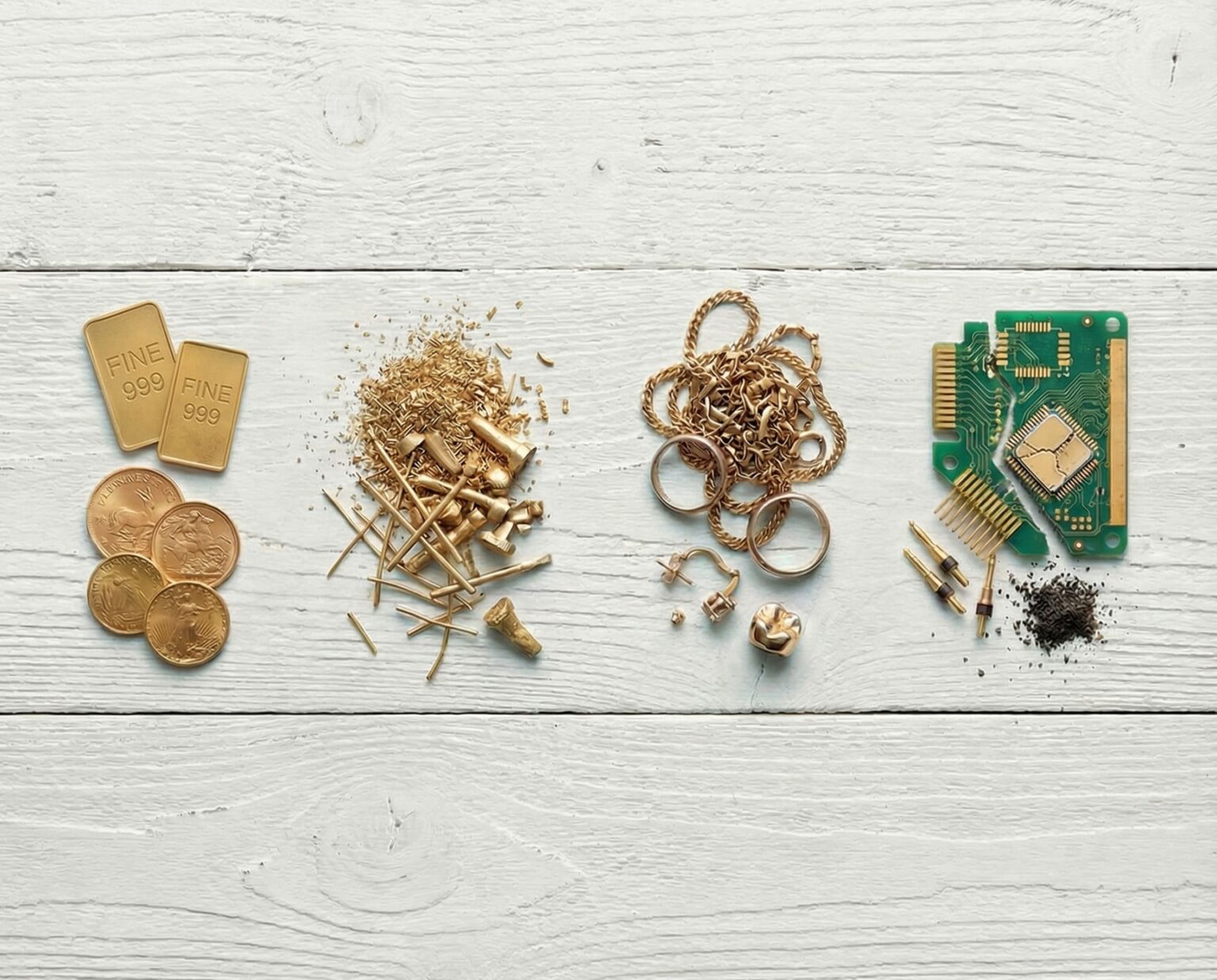
The key lies in distinguishing by the immediate source of the recycled gold: Investment gold, Pre-Consumer material, Post-Consumer gold or actual waste.
In this article, we show you why this distinction is so important and how you can recognise real Post-Consumer recycled gold.
What Does "Recycled Gold" Actually Mean?
The term “recycled gold” is used generously in the jewellery industry as an umbrella term for gold that doesn’t come quite directly (“fresh”) from a mine. The problem: very different material sources hide under this marketing umbrella.
We’ve already written in detail in our article “Why Conventional Recycled Gold Isn’t a Solution” about the general problems of recycled gold. From a lack of traceability to illegal gold entering the market as “recycled”. top of that: recycled gold isn’t a sustainable solution either. Gold has always been reused at nearly 100%. It isn’t plastic or cardboard that would otherwise end up in landfill or in an incinerator without recycling. The gold would have been recycled anyway. Using recycled gold also doesn’t lead to less gold being mined, so globally speaking it saves no CO₂. And it changes nothing about the social or ecological problems in mining.
Anyone who wants real impact – meaning a genuine improvement of the status quo – needs gold that can be traced back to the mine. Like Fairtrade, Fairmined or SMO gold.
Today we’ll look at which different types of “recycled” gold actually exist. Because this distinction makes a big difference between real circular economy and greenwashing.
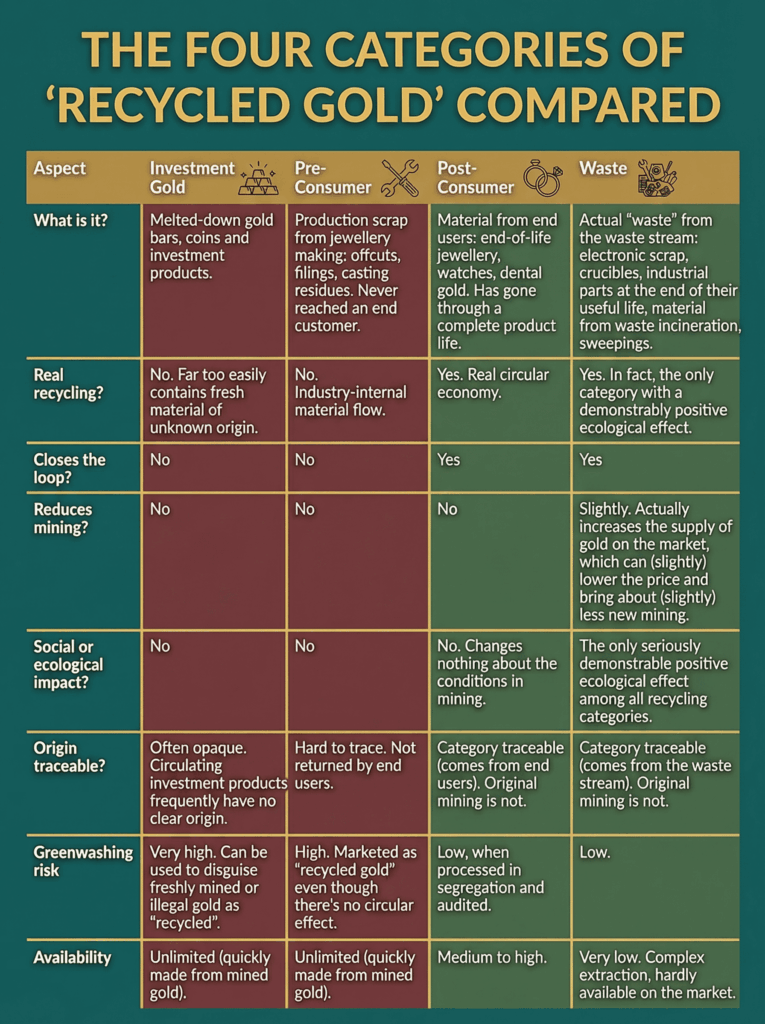
The Four Types of "Recycled" Gold Compared
Investment Gold Remelting
Doesn’t count as real recycling, because it’s already at least 99.9% pure (so it isn’t “waste”) and far too easily contains fresh material of unknown origin.
In detail:
- Could have been recently mined: A bar could have come from a mine, been refined and manufactured just a few days ago. You can’t tell the age of a gold bar by looking at it or determine it any other way.
- No effect on mining: Investment gold circulates in the market constantly anyway. Remelting it isn’t “recycling” in the true sense and changes nothing about the demand for newly mined gold.
- High risk: Investment gold remelting can be used to disguise freshly mined or even illegal gold as “recycled”.
- Opaque supply chains: Circulating investment products usually have no clear origin. Trade is multi-tiered, international and opaque. Pure gold atoms carry no characteristics of their origin.
What is it?
Here, investment products such as gold bars and coins are melted down and reprocessed into other gold products.
That sounds like recycling? So what’s the problem?
That’s exactly where the trick lies. These products are never “waste” in the literal sense of the word. The RJC CoC Standard also explicitly excludes investment gold as a legitimate source for recycled gold.
Pre-Consumer Production Scrap
Strictly speaking, this isn’t real recycling, but merely an industry-internal material flow.
In detail:
- Could have been freshly mined: The material could have come from a mine just days or weeks ago and simply been redirected into production.
- No circular effect: The gold was never with an end user.
- Marketed as “recycled gold” even though it’s just production residue being reused within a closed system.
What is it?
Pre-Consumer material is gold from production scrap that has never reached an end user. These are residues that arise during the manufacturing process.
Examples:
- Casting residues and sprues
- Offcuts from processing
- Rejected semi-finished products
- Workbench production residues
Imagine you’re rolling out cookie dough and cutting out cookies. The leftover dough gets kneaded back together and rolled out again. Would anyone call that “recycling”? Hardly. But that’s exactly what happens with Pre-Consumer gold. It’s still often marketed as “recycled”.
Post-Consumer Recycled Gold
What is it?
Post-Consumer recycled gold is, according to the definitions of the Responsible Jewellery Council (RJC CoC Standard 2024), the SCS-103 (Recycled Content Standard) and the International Organization for Standardization (ISO), material that is generated as waste by households (consumers) or by commercial, industrial and institutional facilities in their role as end users of the product.
Put simply: gold that has completed its first full life as a finished product (a “product life cycle”) and has been returned to the loop by end users.
Examples:
- Post-Consumer gold: End-of-life jewellery, watches, ornaments and dental gold from end users or pawnbrokers.
- Industrial residues: End-of-life residues with less than 2% gold content. For example electroplating baths, soldering alloys, ceramic décor dust or residues from analogue photography.
Why is it the better choice?
- Real circular economy: The gold has already gone through a complete life cycle and remains in the loop.
- Clearly distinguishable: The material comes from end users, not from unclear industry-internal material flows or melted-down bars.
- Lower risk: Lower risk of illegitimate supply chains, when strictly segregated and certified to recognised standards.
Waste
The only category with a seriously demonstrable positive effect
Gold from actual “waste” that ends up in the waste stream: electronic scrap, crucibles, industrial parts at the end of their useful life, low-grade material from waste incineration, sweepings.
Why this category is particularly relevant:
- Actually (slightly) increases the supply of gold on the market. Without the complex recovery from the waste stream, this gold would be lost.
- Can therefore (slightly) lower the price and bring about (slightly) less new mining. This isn’t the case with any other recycling category.
- However, it’s still hardly available on the market due to the complex extraction.
Why This Distinction Matters
Transparency
Post-Consumer gold can’t be traced back to the mine either. But it clearly comes from end users. Not from unclear industry-internal material flows or melted-down bars.
Important: the term “traceable” is reserved for gold that can really be traced back to its origin (a mine). So, for example, Fairtrade, Fairmined or SMO gold. With recycled gold, you know the category, but not the origin. That’s a decisive difference. Anyone who wants full traceability turns to Fairtrade, Fairmined or SMO gold. Here, every step of the supply chain is verifiable, from the mine to the piece of jewellery.
The Risk of Greenwashing
Pre-Consumer and Investment gold are marketed as “recycled gold” even though they don’t close the loop. Pre-Consumer material and Investment gold remelting are often advertised with the same marketing terms as real Post-Consumer gold: “environmentally friendly”, “sustainable”, “climate-neutral”, “recycled”. But these terms are misleading, because Pre-Consumer and Investment gold …
- don’t close the loop,
- don’t ensure that more gold is recycled,
- don’t bring about less gold being mined and ultimately
- change nothing about the social or ecological problems in mining.
The Social Aspect
Low recycled gold prices put small-scale miners under pressure and encourage illegal trade.
As we described in our article “Why Conventional Recycled Gold Isn’t a Solution”, there’s another problem: recycled gold (almost always without proof of origin) is often traded below the regular market price for newly mined gold (with proof of origin). When more and more people prefer recycled gold, price pressure builds across the entire gold market.
The result: small-scale miners – legal as well as illegal – receive low pay for their work. Their gold enters the regular market through obscure channels, only to later be sold as “sustainable” recycled gold.
Why Standards Like RJC CoC Make This Distinction
Only Post-Consumer gold and waste demonstrably close the loop. The Responsible Jewellery Council clearly distinguishes between Post-Consumer and other materials in its Chain of Custody Standard (RJC CoC 2024).
Why? Because only Post-Consumer recycled gold and waste (“material derived from waste”) close the loop and bring material back from end users. Customers would gain a better understanding of where their gold comes from (at least for one step earlier in the supply chain).
In practice, however, this distinction usually only happens within the industry and isn’t communicated transparently to customers (e.g. with percentages of the recycling categories contained).
This distinction isn’t a bureaucratic detail, but can protect against greenwashing and make sure that “recycled” really means “recycled”.
The Fairever Commitment: 100% Post-Consumer Recycled Gold
At Fairever, we’ve made a deliberate choice: we work exclusively with 100% Post-Consumer recycled gold. According to the clear definition of the RJC CoC 2024 Standard and SCS/ISO. This means: end-of-life jewellery, watches, ornaments, dental gold and residues from industrial end users.
(Recycled gold from actual waste, as defined above, would be even better. Since the gold contents are very small and the extraction is very complex, it’s still hardly available on the market. We hope to be able to offer it in the medium term as well.)
Our gold is refined by Stephen Betts & Sons, the oldest assayer in the United Kingdom (founded in 1760). Every batch is melted, refined and tested for 999.9 ‰ fineness.
What we exclude in the process: Pre-Consumer production scrap, Investment gold and, of course, freshly mined gold of unknown origin …
Our Solution: Post-Consumer Gold With and Without Impact Credits
At Fairever, you’ll find Post-Consumer recycled gold in two variants:
- Post-Consumer Recycled Gold 999 casting grain – 100% Post-Consumer recycled gold. Real circular economy.
- Recycled Gold Credit+ Fairmined – The same Post-Consumer gold, combined with Fairmined Credits that support fair working conditions in small-scale mining. Read more in our article Recycled Gold Credit+.
Conclusion: Ask Where Your Gold Really Comes From
Not everything that says “recycled” on the label really has recycled material inside. The distinction between Post-Consumer, Pre-Consumer and Investment gold makes the decisive difference between real circular economy and greenwashing.
What you should take away:
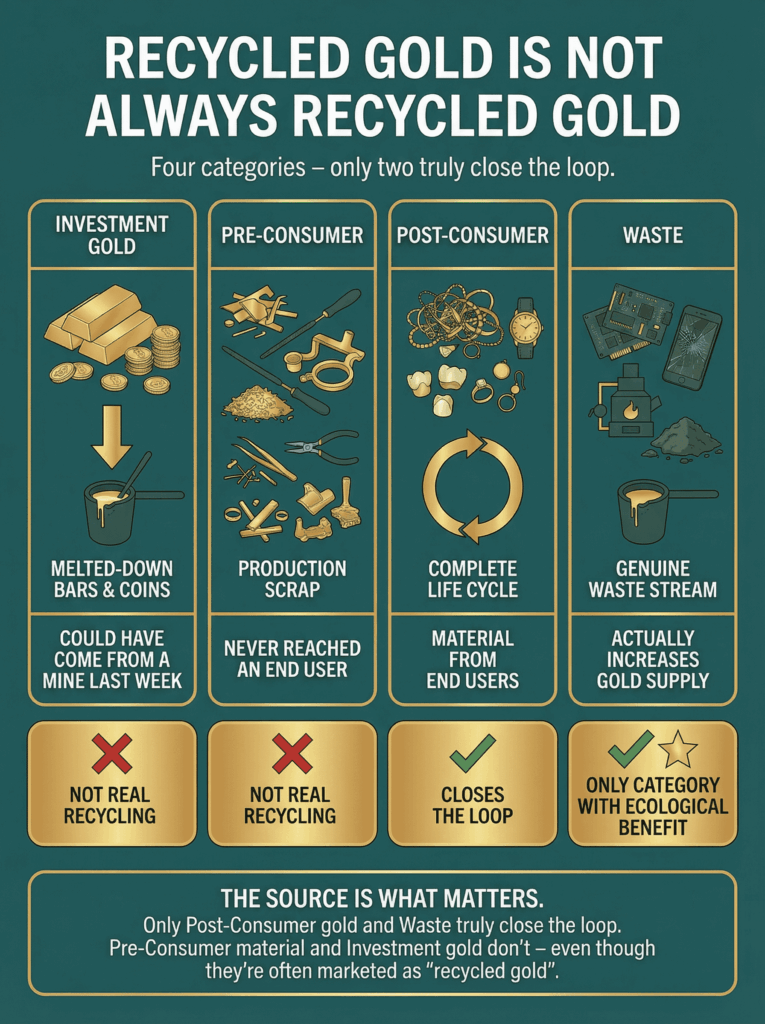
- Post-Consumer recycled gold truly closes the loop. It comes from end users and is real circular economy. But Post-Consumer recycled gold is no substitute for responsibly mined gold either. It doesn’t lead to less gold being mined and changes nothing about the social or ecological problems in mining.
- Pre-Consumer production scrap and Investment gold remelting aren’t really recycling at all. They’re not “waste” in the literal sense, they don’t close the loop and they carry the risk of conflict gold being placed on the market.
- Ask your suppliers specifically: Is your gold Post-Consumer according to the RJC definition and certification? Where does it really come from?
At Fairever, you can rely on this: 100% Post-Consumer recycled gold from genuine end-of-life sources. And with our Credit+ products, you even combine circular economy with social impact in small-scale mining – the best of both worlds!
The Most Important Articles at a Glance: