

When you want to buy sustainable gold, you often face this question: Should you use recycled gold – or newly mined gold from fair small-scale mining? Both approaches have their merits but solve different problems.
Key Insights
Recycled gold reduces new mining demand – but creates no improvement for people in mining.
Responsibly mined gold from certified small-scale mining (Fairtrade, Fairmined) actively improves working conditions, pays premiums to communities, and is fully traceable.
The central difference: Recycled gold is an individual solution for CO₂ reduction – fair gold creates systemic change in mining regions.
Both approaches can complement each other: With Recycled Gold Impact Credits, you can cover your main production and create targeted impact collections with fair physical gold.
What Does Recycled Gold Solve – and What Doesn't It?
Recycled gold initially sounds like the perfect solution: use existing material, no new mining needed. But as with many things, the devil is in the details.
What Recycled Gold Achieves
Gold has been too valuable to throw away for centuries. Old jewelry, dental gold, and electronic waste are melted down, processed into fine gold, and get a second life. The advantage: Recycled gold doesn’t require new mining and reduces CO₂ emissions compared to new extraction. Particularly in processing (Scope 1 and 2 emissions), values are significantly lower than mining from ore.
With Known Provenance Recycled Gold – material with proven origin from specific waste streams like electronic waste – you even have traceability to concrete sources. That’s transparent and verifiable.
What Recycled Gold Does NOT Achieve
But: Recycled gold doesn’t change anything about the problems in today’s gold mining. The social and ecological impacts of the original mining remain – you only rarely know under what conditions the gold was originally extracted.
Recycled gold creates no direct added value for mining communities. There are no premiums, no improvement of working conditions, no investment in infrastructure or education. The people who mine gold under difficult conditions today don’t benefit from you buying recycled gold.
And another crucial point: About 75% of annually processed gold still comes from new mining. The share of recycled gold in global supply has barely changed in recent years despite massively increased demand. Recycled gold doesn’t automatically reduce mining – it only shifts who buys which gold.
Not Everything Labeled "Recycled" Is Sustainable
The term “recycled gold” isn’t uniformly defined. The RJC Code of Practices has distinguished three categories since 2024:
- Post-Consumer Recycled Gold: Old jewelry, dental gold, electronic waste – material that has had its first life
- Pre-Consumer Recycled Gold: Production waste, filings from jewelry manufacturing – material that never reached the end customer
- Bullion Remelt: Melted-down bars or investment coins – with high risk that freshly mined or even illegal gold is being “laundered” here
Only post-consumer recycled gold has genuine sustainability gains. Pre-consumer material and bullion remelt could have been freshly mined just days ago.
At Fairever, we rely exclusively on 100% post-consumer recycled gold from genuine end-of-life sources like old jewelry, watches, dental alloys, electronics, and industrial residues. Each batch is refined to 999.9 fineness – without admixture of pre-consumer scrap or bullion.
More about the different recycling categories and why the distinction is so important can be found in our detailed article “Post-Consumer vs. ‘Regular’ Recycled Gold.”
What Does Responsibly Mined Gold from Small-Scale Mining Achieve?
While recycled gold answers the climate question, responsibly mined gold answers another, equally important question: How can we improve conditions in current gold mining?
The Context: Why Small-Scale Mining Matters
Artisanal and Small-Scale Mining (ASM) accounts for about 20% of global gold production and employs millions of people, especially in developing countries. Without standards and certification, these people often work under precarious conditions: unsafe mines, mercury use, no social security, local exploitation by middlemen.
At the same time, ASM is the only source of income for many families. Simply abstaining doesn’t solve the problem – it requires systemic change.
The Solution: Fairtrade and Fairmined Certification
This is exactly where Fairtrade and Fairmined come in. Both standards are controlled by independent, accredited inspection organizations:
- Fairtrade Gold: Certified by FLOCERT (Fairtrade International)
- Fairmined Gold: Certified by the Alliance for Responsible Mining (ARM)
Both guarantee strict social, ecological, and economic standards along the entire supply chain – from the mine to the finished piece of jewelry.
What These Certifications Concretely Mean
Financial Security and Community Development
Fairtrade and Fairmined guarantee miners a minimum price of 95% of the London Bullion Market Price. This protects them from exploitation by local middlemen who often pay far below world market price.
In addition to the minimum price, mining communities receive a premium – an additional amount per kilogram of gold. This premium is managed democratically by the mines themselves and flows into community projects: schools, health stations, clean water, better infrastructure.
At Fairever, we go even further: We pay 96-99% of the spot price for gold and up to 160% for silver – well above minimum standards.
Social Standards and Labor Rights
Fairtrade and Fairmined require:
- Safe working conditions with health protection
- Fair wages and formalized labor rights
- Protective measures for female workers (e.g., maternity leave)
- Strict prohibition of child labor
- Social security and organizational development
Environmental Protection with Concrete Goals
Both standards set high environmental requirements:
- Reduction or complete elimination of mercury – the biggest ecological problem in small-scale mining
- Closed water circuits to prevent pollution
- Soil remediation after mine closure
- Promotion of clean technologies and CO₂-reducing processes
The goal: ASM mines should work not only more fairly but also ecologically responsibly.
Complete Traceability
A crucial difference from most recycling sources: Every gram of Fairtrade or Fairmined gold is fully traceable. Certification requires segregated supply chains – the gold is processed separately from other material from the mine to the end product. You know exactly which mine your gold comes from and under what conditions it was extracted.
More details on both standards can be found in our articles on the Fairtrade Standard and the Fairmined Standard.
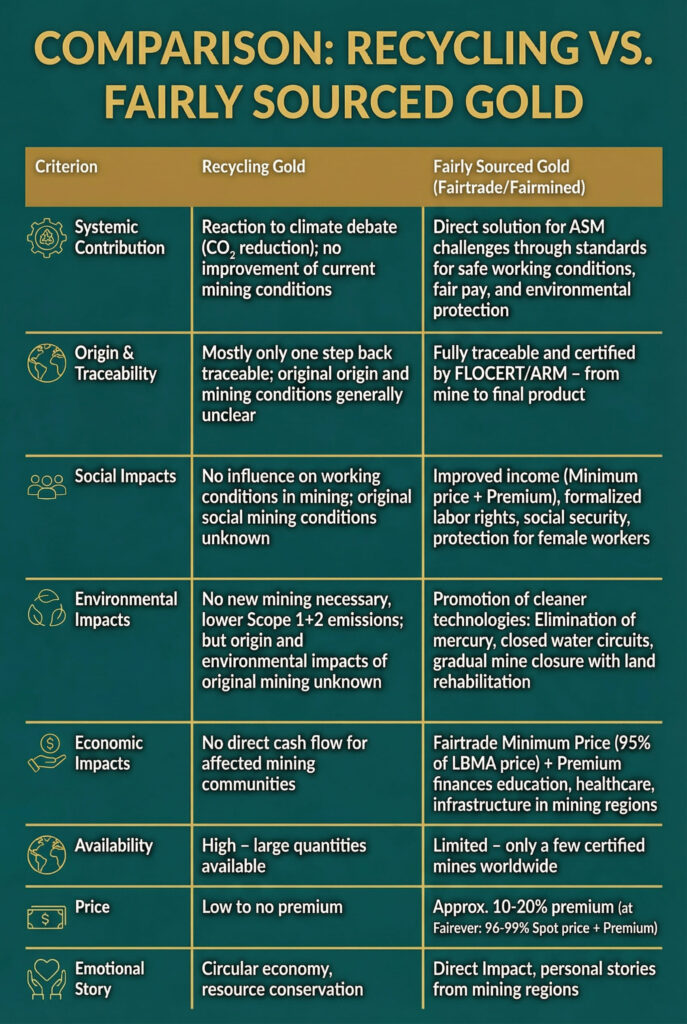
The Comparison: When Does Which Approach Make Sense?
Both paths have their merits – the question is which problem you want to address.
Recycled Gold Is the Right Choice When...
You want to reduce your CO₂ footprint: Recycled gold has lower Scope 1 and 2 emissions than new mining
- You need larger quantities: ASM gold is limited in volume, recycled gold is available in large volumes
- Circular economy is central to your brand communication: Recycling is a strong signal for resource conservation
- Budget plays an important role: Recycled gold has lower premiums than certified ASM gold
But consider: Recycled gold doesn’t improve mining conditions and creates no social impact in mining regions.
Responsibly Mined Gold Is the Right Choice When...
- You want to directly support people in mining regions: With every order, premiums flow into community projects
- Complete transparency and origin guarantee are important: You know exactly which mine your gold comes from
- Your customers appreciate the story behind the gold: Fairtrade and Fairmined offer emotional storytelling with real impact
- You’re willing to pay 10-20% premium for measurable social change: These additional costs go directly to the miners
- You work with premium or impact collections: Responsibly mined gold is perfect for special pieces of jewelry with value beyond the material
The added value: You not only support fair working conditions but actively help formalize and sustainably shape small-scale mining.
The Hybrid Approach: Why "Either-Or" Isn't the Answer
The good news: You don’t have to choose. Recycled gold and responsibly mined gold solve different problems – and can complement each other perfectly.
Example Strategy for Your Product Range
- Basic Production: Use recycled gold or Recycled Gold Credit+ for your volume products. This covers your main needs, reduces CO₂ emissions, and communicates circular economy.
- Premium Collections: Use physical Fairtrade or Fairmined gold for special collections. These pieces of jewelry have an emotional story, are fully traceable, and create direct impact in mining regions.
- Communication: Both approaches show different aspects of your sustainability commitment. Recycled gold stands for your climate strategy, responsibly mined gold for your social commitment.
This way you combine climate protection AND social change in mining – without compromises in availability or budget.
Conclusion: Different Problems Need Different Solutions
Recycled gold answers the question: “How can we mine less new gold?” It reduces CO₂ emissions, closes material cycles, and is available in large quantities. But it doesn’t improve mining conditions and creates no social impact for people who mine gold under difficult conditions today.
Responsibly mined gold from certified small-scale mining answers the question: “How can we improve conditions in current gold mining?” It creates fair working conditions, supports communities through premiums, makes supply chains transparent, and helps formalize informal small-scale mining.
Both approaches aren’t competition but complement each other. The best strategy for you depends on your priorities – or you combine both paths for holistic sustainability.
If you want to learn more about how to integrate responsibly mined gold into your production, feel free to contact us. We’ll help you find the right path for your brand.
Further Articles:
- What Is Recycled Gold – Our detailed article on the different recycling categories
- The Fairtrade Standard for Gold – All details on Fairtrade certification
- The Fairmined Standard for Gold – How Fairmined is changing small-scale mining
- Recycled Gold Credit+ – Our hybrid product for maximum impact
Sources:
- Alliance for Responsible Mining (ARM): www.fairmined.org
- Fairtrade International: www.fairtrade.net
- Responsible Jewellery Council: Code of Practices 2024