
Recycled gold is marketed as a climate-friendly alternative. But is it really sustainable – and what does that even mean? The answer is more complex than most marketing promises suggest.
Key Insights
- Recycled gold doesn’t save any CO₂. Mining causes 99% of emissions. With recycled gold, this step has already happened in the past – but the emissions haven’t disappeared. And because recycled gold doesn’t lead to less mining, no CO₂ is saved globally.
- The source is what matters. Only Post-Consumer gold (from end users) truly closes the loop. Pre-Consumer material (production scrap) isn’t real recycling at all, but an industry-internal material flow. Investment gold (remelted bars) is usually already at least 99.9% pure gold and can’t seriously be called “recycling”.
- Recycled gold doesn’t solve the social problems in mining. 15–20 million people work in small-scale mining – often under dangerous conditions. Recycled gold doesn’t improve their situation.
- 75% of the gold processed worldwide is still newly mined. Despite recycling, mining is actually increasing due to high gold prices, especially in the small-scale mining sector.
Why Recycled Gold Isn't More Climate-Friendly
99% of emissions from mined gold come from mining itself. Recycled gold is often marketed as “climate-friendly” because, on paper, this step doesn’t happen again. But this calculation has several fundamental problems.
Where the Emissions in Mined Gold Come From
For a single ounce of gold (31.1 grams), an average of 150 tonnes of rock have to be blasted, transported and processed. Heavy machinery, diesel trucks, kilometre-long transport routes, chemical ore processing with cyanide – all of this consumes enormous amounts of energy.
Refining itself – melting and chemical purification – accounts for only about 1% of total emissions.
Why Recycled Gold Still Doesn't Save CO₂
Recycled gold was also mined – possibly only a few weeks ago. The emissions from mining haven’t disappeared just because the gold is now being remelted. They’re carried along with the material as a “CO₂ backpack”.
What does occur during the refining of recycled gold: collecting and transporting the material, sorting (in the case of electronics), melting and chemical purification. On paper, the CO₂ footprint is around 30–50 kg per kilogram of gold. For mined gold, it’s about 30,000 kg – 600 times as much.
But this calculation only works thanks to an accounting trick: the emissions of the original mining are set to zero (the so-called “cut-off approach”). The CO₂ backpack from mining doesn’t disappear through refining – it’s just no longer counted. And every reprocessing step actually increases gold’s overall CO₂ footprint even further.
The decisive point: using recycled gold doesn’t mean more gold is recycled, less mining takes place, or less CO₂ is emitted globally. As long as gold demand keeps rising, mining will keep rising too – regardless of how much “recycled gold” is in circulation. And that’s exactly what makes the difference between recycling gold and recycling other materials.
Four Myths About Recycled Gold
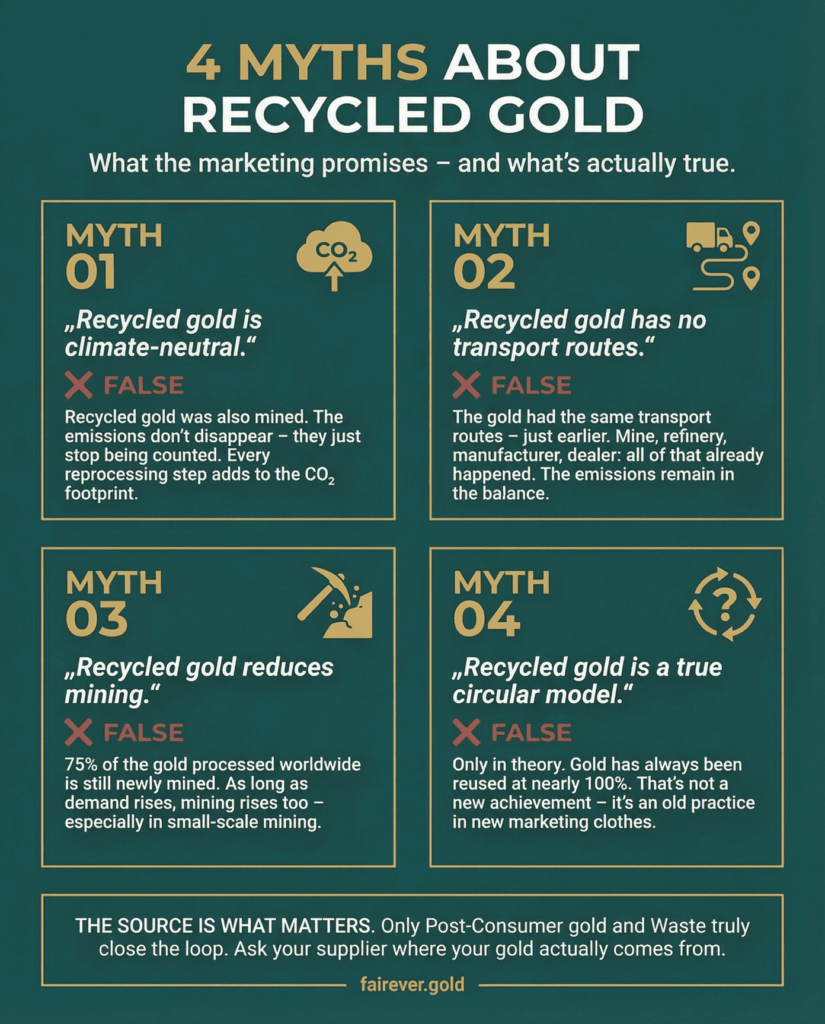
Myth 1: "Recycled Gold Is Climate-Neutral"
False. Recycled gold is neither climate-neutral nor more climate-friendly than mined gold – at least not in the global picture. Because using recycled gold doesn’t mean that more gold gets recycled and less gold gets mined. The demand for newly mined gold stays the same.
Melting and reprocessing is also energy-intensive in itself. Furnaces run at 1,200°C, aqua regia has to be produced, electrolysis consumes electricity. Every reprocessing step increases gold’s overall CO₂ footprint.
On top of that: gold has always been reused at nearly 100%. Gold isn’t plastic or cardboard – it’s practically never thrown away. The gold would have been recycled anyway. Using recycled gold has no benefit for the climate.
Myth 2: "No Transport Routes With Recycled Gold"
False. The gold had the same transport routes – just earlier. The recycled gold being melted today was also transported from a mine at some point. To the refinery, to the manufacturer, to the dealer, to the customer.
The difference: those transports happened 5, 10 or 20 years ago – or maybe just a few weeks ago. The emissions remain in the overall balance.
What does change: for a new product, the transport from the mine to the first processing step no longer applies. The routes are shorter. That’s a small advantage, but not a big one. The relevant emissions are in mining itself – and that’s still happening.
Myth 3: "Recycled Gold Reduces Mining"
False. 75% of the gold processed worldwide each year is still newly mined. Global gold demand far exceeds the available recycled supply.
Without newly mined gold, demand can’t be met. Industrial mining remains at high levels. Small-scale mining is even increasing in line with the gold price.
High gold prices make previously unprofitable deposits attractive. People in poorer regions start mining – often without environmental standards, with mercury use.
The problem: recycled gold only covers around 23% of global gold demand. Total demand is rising faster than the supply of recycled gold can grow, since nearly 100% of gold has always been reused anyway.
Sources: World Gold Council, Fairtrade International
Myth 4: "Recycled Gold Is a Circular Model"
Only in theory. In practice, demand is rising continuously. Without additional demand, gold could function as a circular model – but jewellery, investment products and electronics need more and more gold.
Gold has never been thrown away in the past either. It has always been melted down and reused. That’s not a new achievement – it’s an existing practice that’s simply being marketed differently today.
Source: Fairtrade International
What Recycled Gold Does NOT Solve
Recycled gold answers neither the social nor the ecological questions of gold mining.
1. The Social and Ecological Problems in Mining
15 to 20 million people work in small-scale mining worldwide – often under dangerous conditions. Recycled gold doesn’t change that.
The reality: mercury use without protective equipment, child labour, no social security, health risks from heavy metals, exploitation by middlemen.
Recycled gold doesn’t improve working conditions. It doesn’t generate any cash flow for affected communities. It offers no alternative for people who depend on mining.
The original mining conditions remain unclear. You don’t know under what circumstances the gold in your jewellery piece was extracted.
What actually helps: Fairtrade and Fairmined Gold
Standards like Fairtrade and Fairmined start exactly here. They improve conditions directly on the ground:
- Minimum prices protect miners from exploitation by middlemen
- Premium payments finance schools, healthcare and infrastructure in mining communities
- Reduction of mercury and promotion of cleaner technologies
- Occupational safety standards: safe working conditions, protective equipment, ban on exploitative child labour
- Formalisation: legal protection, access to fair markets
The difference: Fairtrade and Fairmined Gold create real change for the people who live from mining. Recycled gold doesn’t.
2. The Question of Origin Stays Open
With conventional recycled gold, the origin is usually unclear. The original mining conditions can’t be traced.
You don’t know:
- Where and when was the gold originally mined?
- Under what conditions? (Occupational safety? Child labour? Mercury?)
- Which country does it really come from?
Important: the term “traceable” is reserved for gold that can really be traced back to the mine – meaning Fairtrade, Fairmined or SMO gold. “Old gold” is not an origin; there’s no real traceability here.
The Dubai example: a SWISSAID study (2020) shows that gold from conflict regions is “washed” through Dubai and sold as recycled gold. Controls have been shown to be inadequate.
Gold from the Congo is imported via France – then France counts as the “country of origin”. The gold gets melted down, ends up on the market, and no one knows where it came from anymore.
3. Mining Continues Unabated
75% of the gold processed worldwide each year is newly mined. Mining is actually increasing due to high gold prices – especially in the small-scale mining sector.
Recycled gold doesn’t replace new mining – it only adds to it. The recycling rate is already close to 100% – so supply can’t be expanded here. As long as demand keeps rising, gold will keep being pulled out of the ground.
Source: Fairtrade International
The Source Is What Matters
Not everything sold as “recycled gold” is equivalent. The decisive difference lies in the source.
Investment Gold
This isn’t real recycling, because it’s already at least 99.9% pure (so it isn’t “waste”) and far too easily contains fresh material of unknown origin. Here, gold in the form of bars and coins is melted down and misleadingly brought back onto the market as “recycled gold”.
Why it isn’t a solution:
- The bars could have come from a mine just a few weeks ago
- No real loop, no environmental benefit
- Often via opaque supply chains (e.g. from Dubai) – without reliable proof of origin
- Gold from conflict regions can enter the market “legally” this way
Pre-Consumer Material
This isn’t real recycling, but an industry-internal material flow. Production scrap from jewellery making – offcuts, filings, casting residues. Material that never reached an end user.
Why it’s problematic:
- It was mined – possibly only a few weeks ago
- No end user was ever involved, so there’s no real circular effect
- It’s still often marketed as “recycled gold”
Post-Consumer Recycled Gold
This is real recycling: end-of-life jewellery, watches, dental gold, electronic scrap from end users. Material that has gone through a complete life cycle.
Why it’s the better choice:
- It really closes the loop – the material comes back from end users
- It uses material that has reached the end of its product life (e.g. damaged jewellery)
- It can be clearly distinguished from freshly mined material
Waste
Actual “waste” that ends up in the waste stream – e.g. electronic scrap, crucibles, industrial parts at the end of their useful life, low-grade material from waste incineration, sweepings. There are 210 million discarded mobile phones lying in German drawers alone!
Why this category is particularly relevant:
- It actually (slightly) increases the supply of gold on the market
- It can (slightly) lower the price and lead to (slightly) less new mining
- It’s the only recycling category where you can seriously talk about a positive ecological effect
- However, it’s still hardly available on the market due to the small quantities and complex extraction
Conclusion: only Post-Consumer gold and Waste recycling truly close the loop. Strictly speaking, Pre-Consumer and Investment gold aren’t real recycling at all – even though they’re often sold as “recycled gold”.
Read more: Is Recycled Gold really Recycled?
Recycled Gold at Fairever
Fairever works exclusively with Post-Consumer recycled gold – the only available category that truly closes the loop. End-of-life jewellery, dental gold, electronic scrap, industrial end-of-life residues. We explicitly exclude Pre-Consumer material and Investment gold.
Every batch is tested for 999.9 fineness. Our refinery is Stephen Betts & Sons, the oldest assayer in the United Kingdom (founded in 1760).
Recycled gold from actual “waste”, as defined above, would be even better. Since the quantities are very small and extraction is very complex, it’s still hardly available on the market. We hope to be able to offer it in the medium term as well.
What Recycled Gold Alone Doesn't Achieve
Post-Consumer recycled gold is real circular economy. But it solves neither the social nor the ecological problems in mining. 15 to 20 million people work in small-scale mining – many under dangerous conditions.
That’s why we additionally offer products made from:
Recycled Gold Credit+ Fairmined
The same Post-Consumer gold – combined with “Fairmined Credits”. For every gram purchased, a credit is acquired. This guarantees that, somewhere else, one gram of gold has been mined under fair conditions.
- Minimum prices protect miners from exploitation
- Premium payments finance education, healthcare and infrastructure in mining communities
- Labour standards guarantee safe conditions and prohibit exploitative child labour
This way, you combine circular economy with social impact.
Read more: Recycled Gold Credit+: Recycled gold that truly makes a difference
Conclusion
Recycled gold is neither sustainable nor climate-friendly in the true sense. Using recycled gold doesn’t lead to more recycling or less mining, and saves no CO₂ globally. And it doesn’t solve the social problems for the millions of people who depend on gold mining.
The source is what matters: only Post-Consumer gold truly closes the loop. Pre-Consumer material and Investment gold change nothing about the demand for new mining.
The reality: 75% of the gold processed worldwide is still newly mined. Recycling alone isn’t a solution – but combined with fair standards, it can be part of the answer.
What you can do: ask specifically: Where does the gold come from? Is it Post-Consumer? Which social standards are met? Only with transparency does recycled gold become real circular economy.
The Most Important Articles at a Glance: